
Lame Elastic Parameters: Keep Bulk and Shear Responses Distinct
2026-11-25
Lame Elastic Parameters: Keep Bulk and Shear Responses Distinct
Lame Elastic Parameters express a three-dimensional isotropic linear-elastic stress law using two coefficients. In a robot-component model record, those coefficients should not be confused with every other quantity called a modulus. In particular, the first Lame parameter is not generally the bulk modulus, even though both have stress units.
Declare small mechanical strain and three dimensions
Let epsilon be the symmetric small-strain tensor, with thermal or other imposed strains excluded from this independent mechanical example. For a homogeneous isotropic linear-elastic material, write sigma = two G epsilon plus lambda times the trace of epsilon times the identity tensor. Here G is the shear modulus, also commonly written mu.
FreeFEM's original elasticity explanation gives this constitutive relation and the conversion from Young's modulus and Poisson's ratio. A. F. Bower's original solid-mechanics text defines bulk, shear and Lame moduli and distinguishes their physical interpretations. The calculations below use invented positive coefficients rather than either source's material table or beam example.
The trace is the sum of the three normal strains. In this small-strain model, it approximates the fractional volume change. It is not a fourth independent strain component or the magnitude of a vector assembled from all tensor entries.
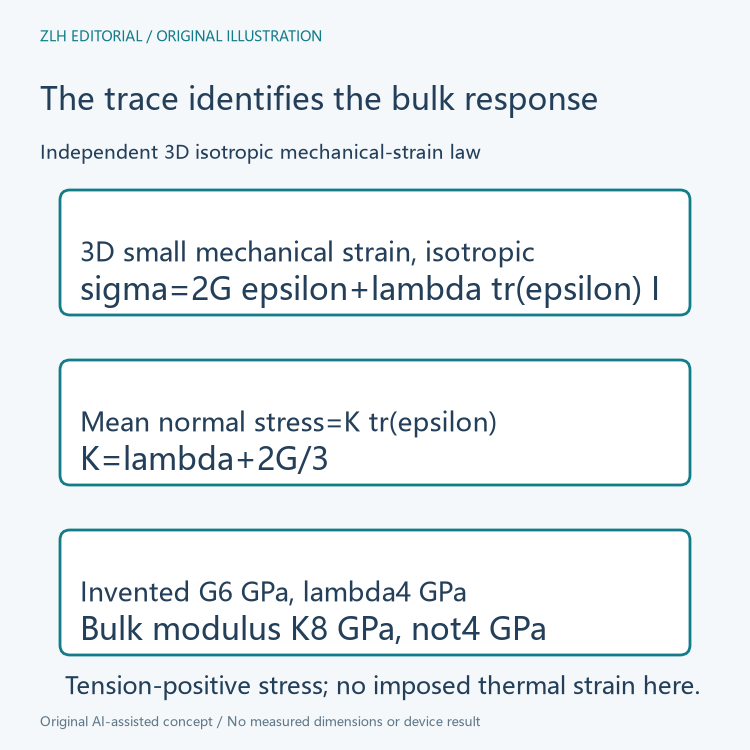
Taking the trace identifies the bulk response
Taking the trace of the stress law gives trace sigma = (two G plus three lambda) times trace epsilon. Dividing by three shows that mean normal stress equals K times volumetric strain, where K = lambda plus two G divided by three.
The extra term comes from the trace of the two G epsilon contribution. Ignoring that term and labeling lambda as K would therefore change the volumetric response. No coordinate rotation can remove this algebraic difference between the two coefficients.
This explanation uses tension-positive normal stress. For uniform compression, the mean normal stress and the volume strain are both negative. A separately defined positive pressure is minus the mean normal stress; its sign convention must be stated before copying a compression equation into a report.
An independent uniform-strain example checks the total
Choose G equal to six gigapascals and lambda equal to four gigapascals. The resulting bulk modulus is eight gigapascals. Now choose each normal strain as 0.001, with every shear component zero. The trace is 0.003.
Each normal stress has a two G contribution of 0.012 gigapascal and a lambda contribution of another 0.012 gigapascal. The total is 0.024 gigapascal, or twenty-four megapascals, in each direction. The independent bulk calculation gives eight gigapascals times 0.003, agreeing with that total.
Using lambda alone as the bulk modulus would instead give twelve megapascals. That is only half the correct mean stress for this selected model. The example tests coefficient interpretation and does not assign any allowable stress to a real component.
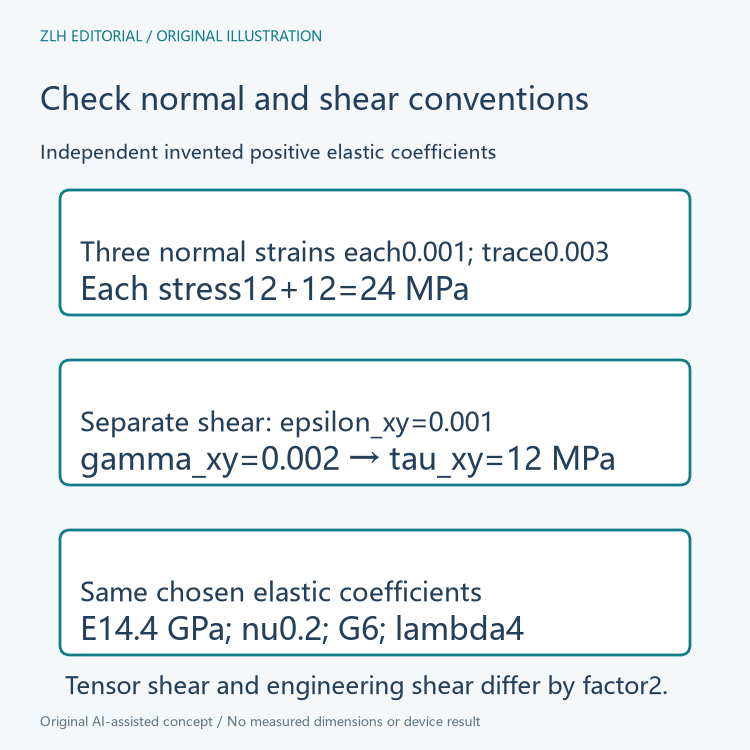
A shear component exposes the factor-of-two convention
For a separate infinitesimal pure-shear strain example, let epsilon xy and epsilon yx each equal 0.001 and all normal strains be zero. The trace vanishes, so the lambda term makes no contribution. The xy stress is two G times 0.001, giving twelve megapascals.
The corresponding engineering shear strain gamma xy is 0.002, twice the tensor shear entry. Thus the same stress is G times gamma xy. Mixing tensor shear strain with an engineering-shear coefficient would lose a factor of two, even though the physical deformation being described is unchanged.
This is also why a matrix representation of elasticity must declare its strain-vector convention. A list containing six entries does not by itself reveal whether the off-diagonal entries are tensor strains, engineering strains or another scaled representation.
Convert coefficients with their assumptions intact
For the selected coefficients, Young's modulus is 14.4 gigapascals and Poisson's ratio is 0.2. Substituting them into G = E divided by two times one plus nu gives six gigapascals. Substitution into lambda = E nu divided by the product of one plus nu and one minus two nu gives four gigapascals.
These are three-dimensional isotropic relations. A reduced two-dimensional plane-stress equation may contain a different effective coefficient after eliminating the out-of-plane response. That reduced coefficient should not be silently substituted into the unreduced three-dimensional law used here.
A constitutive law is separate from a component result
The stress fields in an actual part also depend on geometry, loads and boundary conditions. Knowing two elastic coefficients does not identify yielding, fracture, residual stress or a complete service limit. The model assumes small reversible strains and does not supply a plasticity law.
Related material appears in elastic model principles and robot component information. Primary references are FreeFEM's original elasticity definition and Bower's original modulus relationships. Both original AI-assisted diagrams show invented coefficient arithmetic, not measured strain maps or certified component performance.