
Debye Lattice Heat Capacity: Count Modes Before Comparing
2026-11-25
Debye Lattice Heat Capacity: Count Modes Before Comparing
Debye Lattice Heat Capacity describes how collective vibrations contribute to the heat stored in an idealized solid. In a cryogenic sensor or precision mechanism record, a statement that heat capacity falls rapidly on cooling needs a temperature range, a material scope and a definition of the reported quantity. A cubic temperature trend is a limiting model, not a universal description of every contribution in an assembled instrument.
Count collective modes rather than identical local oscillators
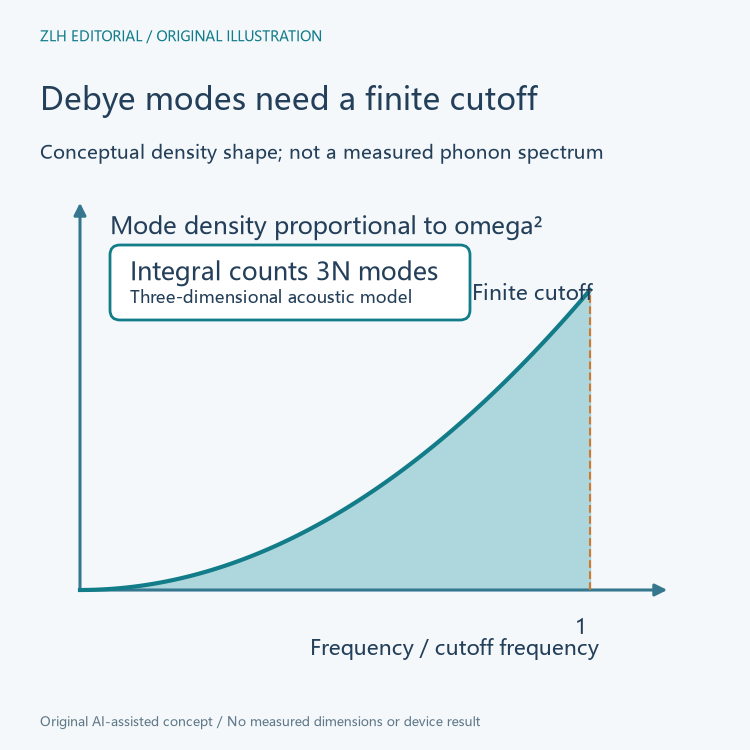
The original TU Delft Debye-model lesson starts from collective acoustic vibrations. In its three-dimensional continuum approximation, the number of allowed wavevectors inside a sphere grows as the cube of the sphere radius. Differentiating that count gives a mode density proportional to the square of angular frequency when the acoustic dispersion is linear.
The three vibration polarizations contribute to the count. A simplified treatment represents them with an effective sound speed. Real crystals can have different branch speeds and directional behavior, so that simplification is part of the model rather than a statement that every branch has the same measured dispersion.
For N atoms, the full vibrational description has three N modes. Extending a continuum frequency density indefinitely would count too many. The Debye construction therefore introduces an upper angular frequency chosen so that integrating the adopted density gives exactly three N modes.
A finite cutoff is a bookkeeping constraint
The Debye temperature is the energy corresponding to that cutoff, divided by Boltzmann's constant. It sets a comparison scale between temperature and the assumed frequency distribution. It is not a temperature at which all vibration suddenly stops or a required operating point for a sensor.
The first original diagram connects the assumed square-frequency density to the finite mode count. Its normalized frequency coordinate and count are conceptual. They do not reconstruct a measured phonon spectrum, and the drawn boundary should not be interpreted as the detailed shape of an actual crystal's dispersion relation.
There is also a distinction between a constant zero-point energy and the temperature-dependent vibrational energy. A temperature-independent term does not contribute to the derivative defining heat capacity. That observation does not justify ignoring a frequency cutoff when counting the available modes.
The low-temperature cubic law follows from the integral
At temperatures small compared with the Debye scale, the thermally populated modes lie mainly at low frequencies. In the energy integral, changing variables from frequency to frequency divided by temperature produces a fourth power of temperature multiplying a dimensionless integral. In the low-temperature limit that integral approaches a constant.
Differentiating the thermal energy with respect to temperature then produces a lattice heat capacity proportional to the third power of temperature. Writing this as C lattice equals beta times T cubed is convenient, provided beta belongs to the stated amount of material and the temperature interval remains within the adopted limiting regime.
For a fictional comparison, choose a reference temperature Tref and a reference lattice heat capacity Cref. Let both the reference and all compared temperatures remain well inside the low-temperature regime. At temperature ratios one, two and three, the predicted heat-capacity ratios are one, eight and twenty-seven.
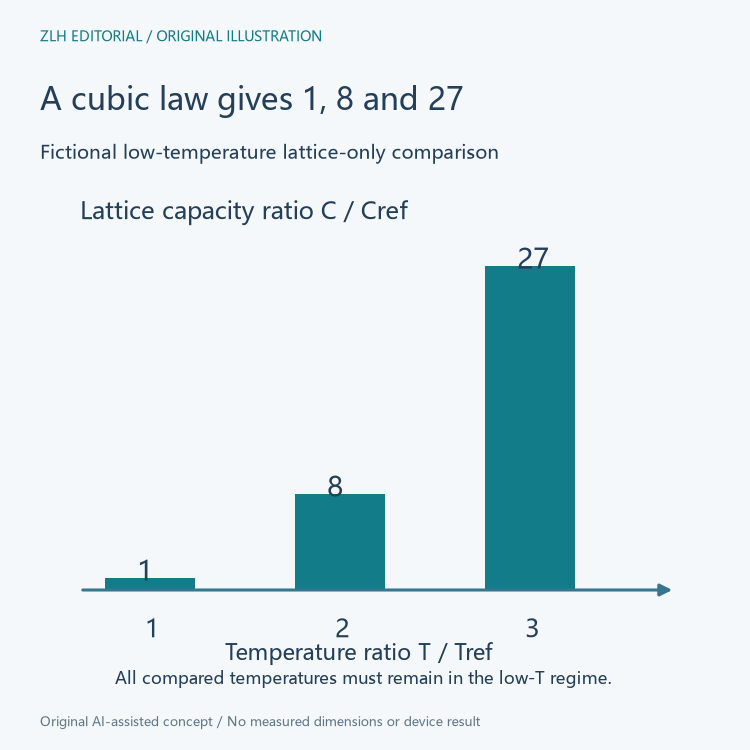
Those ratios follow from the same coefficient beta. They are not evidence that a particular assembly has been cooled or measured. If tripling the reference temperature leaves the low-temperature regime, the final ratio is no longer justified by this limiting calculation.
The high-temperature limit checks the mode count
The original TU Delft Einstein-model lesson provides a useful comparison. It treats independent quantum oscillators with a common characteristic frequency. Both that model and the Debye treatment recover the classical high-temperature value of three N times Boltzmann's constant for the full solid's vibrational heat capacity.
The important difference appears at low temperature. A common-frequency Einstein model freezes out exponentially, whereas the Debye model retains a continuum of low-frequency acoustic modes and gives the cubic limiting law. Merely observing that both approaches contain quantum oscillators does not make their low-temperature predictions interchangeable.
The high-temperature limit is also a normalization check. Doubling the amount of otherwise identical material doubles N and its extensive heat capacity. It does not double the heat capacity per atom. A data table that changes the quantity's denominator can appear inconsistent even when the underlying mode counting is unchanged.
Keep lattice capacity separate from a complete heat budget
This article concerns constant-volume lattice heat capacity in the stated idealization. A reported constant-pressure value, a mass-specific capacity and a total capacity in joules per kelvin are different quantities. Electronic, magnetic and other contributions can matter in real materials; coatings, wiring and fixtures add their own thermal storage to an instrument.
A useful handover therefore records temperature, amount or mass normalization, the capacity definition and whether the number is measured or model-derived. The fictional diagrams support the thermal measurement learning section and equipment information directory. They show why a low-temperature lattice law can aid interpretation while remaining insufficient to certify an entire sensor's response or thermal time constant.