
Rotation Matrix Rates Need an Expressed In Frame
2026-11-26
Rotation Matrix Rates Need an Expressed In Frame
Rotation Matrix Rates in a robot pose log need a frame convention before their entries can describe angular velocity. A rotation matrix has nine entries, but a rigid body's instantaneous rotational motion has three independent components. Differentiating those nine entries does not create nine independent angular speeds. Multiplying the derivative by the appropriate transpose exposes a skew symmetric matrix with the expected three component structure.
State which direction the rotation maps coordinates
Let R map a vector's body frame coordinates into world frame coordinates, using column vectors. The columns of R are therefore the body's three unit coordinate axes expressed in world coordinates. Assume a differentiable proper rotation with R transpose times R equal to the identity and determinant positive one. Time is measured in seconds.
The original Modern Robotics angular velocity lesson uses this body relative to space convention. The MIT graphics lecture independently derives the rate of a rotating body vector from the angular velocity cross product and then applies that relationship to each column of the orientation matrix. Both sources describe a derivative of a rigid orientation, rather than a general time varying scale or shear matrix.
Remove the current orientation on the correct side
Write Rdot for the derivative with respect to time. The spatial angular velocity matrix is Omega_world=Rdot R transpose. Since R R transpose equals the identity, differentiating that identity gives Rdot R transpose plus R Rdot transpose equal to zero. The second term is the transpose of the first, so Omega_world is skew symmetric.
For a vector omega=(a,b,c), the cross product matrix has rows (0,−c,b), (c,0,−a), and (−b,a,0). Multiplying this matrix by another vector produces omega crossed with that vector. Under this convention, recover omega from matrix entries (3,2), (1,3), and (2,1), using ordinary one based mathematical row and column labels. Switching the cross product order reverses the sign.
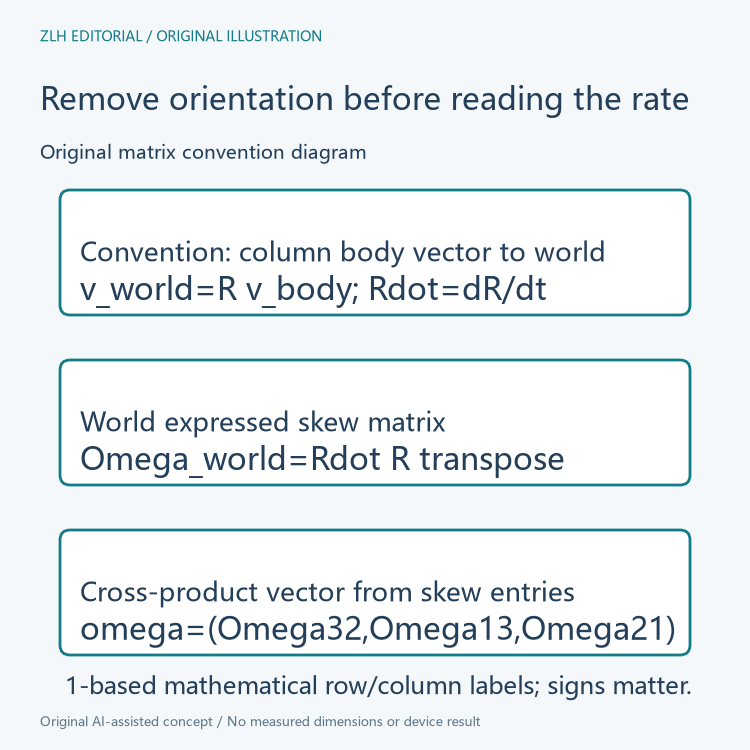
The first original diagram connects the derivative to the skew matrix and identifies those three entries. Rdot itself generally is not skew symmetric. It lives at the current orientation, while Rdot R transpose expresses the angular velocity in the world axes. Replacing one with the other would omit the orientation needed to interpret the derivative.
Radians are dimensionless in this matrix expression, while time contributes inverse seconds. An angular velocity magnitude can still be reported in radians per second to preserve its physical interpretation. It should not be confused with a matrix entry rate labeled in degrees per second unless a separate angle parameter and conversion have been defined.
Body coordinates use the other product order
The same motion has body expressed matrix Omega_body=R transpose Rdot. This is also skew symmetric, now using the body's instantaneous axes. The vector relationship is omega_body=R transpose omega_world. Equivalently, Rdot=Omega_world R=R Omega_body. These are two coordinate descriptions of one angular velocity, not two different physical rotations.
The order matters because a rotation matrix and a skew matrix generally do not commute. Moving the transpose from the right side to the left while keeping the same vector label silently changes the expressed in frame. A log field named only omega without that frame can therefore be ambiguous even if every numerical value was calculated consistently.
Verify an instantaneous example with exact integers
At one invented instant, choose R with rows (0,−1,0), (1,0,0), and (0,0,1). This is a positive quarter turn about world z. Assign omega_world=(2,0,0) radians per second. Its skew matrix has rows (0,0,0), (0,0,−2), and (0,2,0). Multiplication Omega_world R gives Rdot with rows (0,0,0), (0,0,−2), and (2,0,0).
Now calculate both products from that derivative. Rdot R transpose returns the stated world skew matrix and therefore vector (2,0,0). R transpose Rdot instead gives rows (0,0,−2), (0,0,0), and (2,0,0), which correspond to omega_body=(0,−2,0). Independently multiplying R transpose by the world vector gives the same body components.
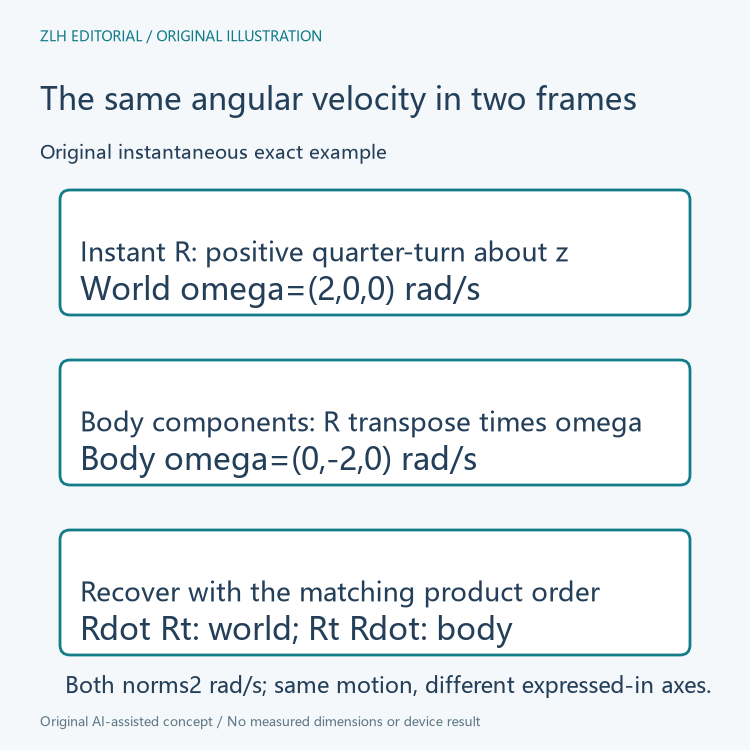
Both vectors have magnitude two. The different component locations and sign arise because the body axes are turned relative to the world axes. Nothing about the coordinate change reverses the actual motion. The example specifies only instantaneous R and Rdot; it does not assert constant angular velocity over a recorded trajectory.
Discrete measurements add a separate estimation question
A finite difference between two sampled matrices estimates a derivative; it is not the exact derivative assumed above. Rounding, sample spacing, time alignment, and nonorthogonal input matrices can produce a product with a nonzero symmetric part. Taking the skew part may be useful in an explicitly chosen estimator, but that operation alone does not repair the observations or establish their physical accuracy.
For a handover, retain the mapping direction of R, vector convention, time units, expressed in frame, and derivative estimation method. The robot data collection and technical article directory provide related context. Original sources are the Modern Robotics angular velocity lesson and MIT Lecture 22 rigid body notes. Both illustrations contain newly constructed arithmetic, with no robot or inertial sensor experiment.