
Darboux Frame Curvature on a Sphere and Its Equator
2026-11-26
Darboux Frame Curvature on a Sphere and Its Equator
A circular path on a sphere bends in space even where its direction follows a geodesic on the surface. The Darboux frame separates the space curve's turning into one component across the surface tangent plane and another within it. The two components can be checked by simple dot products. An invented latitude at height six on a sphere of radius ten gives both nonzero values. An equator on the same sphere then supplies a direct comparison.
Choose the surface orientation and direction of travel
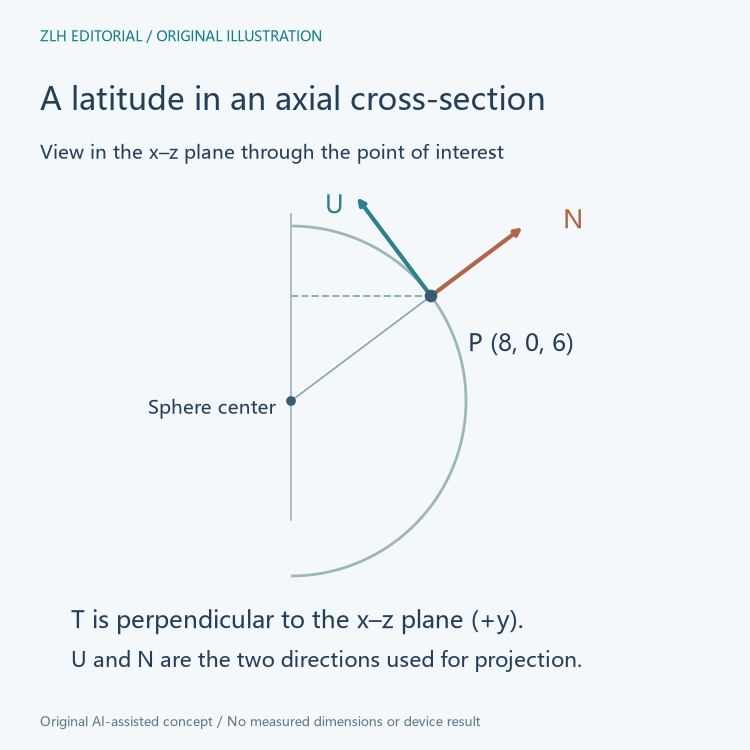
Put the sphere center at the origin and choose the outward unit normal N. Let the latitude lie in the plane z = 6. Since the sphere radius is ten, its circular cross-section has radius eight by the Pythagorean relation. Use the point P = (8, 0, 6) and follow the direction of increasing polar angle around the vertical axis. The unit tangent T at that point is (0, 1, 0). The outward normal is the position divided by ten, giving (0.8, 0, 0.6).
The remaining vector in the Darboux frame is U = N × T. It points along the surface tangent plane across the path, and at P its components are (−0.6, 0, 0.8). The vectors T, U and N are mutually perpendicular and have unit length. Their order is right-handed, with T × U = N. The outward normal tells which side of the sphere is positive. The direction of travel fixes which side of the path is measured by U.
Differentiate the tangent with respect to arc length
Use s for length measured along the circle. Around the latitude, the position is (8 cos(s/8), 8 sin(s/8), 6). Differentiating once yields a unit tangent. Differentiating that tangent at s = 0 yields (−1/8, 0, 0), pointing directly toward the center of the latitude circle in its own plane. This vector is the change in the tangent per unit path length. Both curvature components therefore have units of inverse length. Using the polar angle itself as the parameter would omit the factor that turns angular change into change per unit path length.
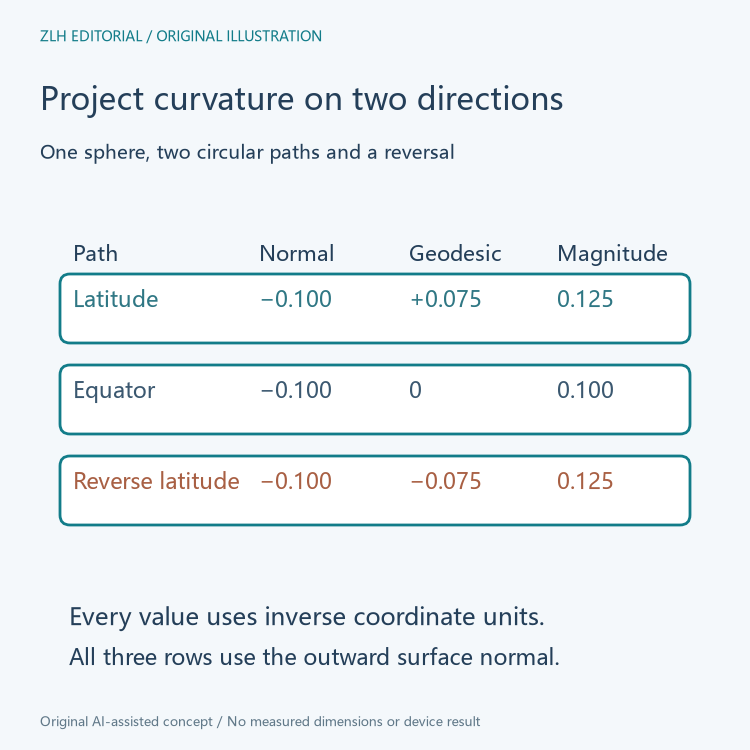
The signed normal curvature is the dot product of the tangent derivative with N. Here (−1/8)(0.8) gives −0.100 inverse coordinate units. The negative sign says that component points opposite the chosen outward normal. The signed geodesic curvature is the dot product with U, giving (−1/8)(−0.6) = +0.075. The positive sign says that this part points toward U in the tangent plane. Adding −0.100N and +0.075U reconstructs the original horizontal vector exactly.
Compare the latitude with the equator
At (10, 0, 0) on the equator, for the same direction of travel, T is (0, 1, 0), the outward normal is (1, 0, 0) and U is (0, 0, 1). The derivative of T with respect to length is now (−0.100, 0, 0), so the normal component stays at −0.100 and the geodesic component is zero. The equator still has space curvature of magnitude 0.100. Its change of tangent lies entirely along the surface normal, which is the geodesic condition for this surface.
For the chosen latitude the magnitude of the space curvature is 0.125. The components independently give the same result because the vectors U and N are orthogonal: the square root of (0.100)² + (0.075)² is 0.125. That checks the projections against the reciprocal of the latitude circle's radius. The two paths have the same signed normal curvature because the sphere has the same normal curvature in every tangent direction under the outward-normal convention.
Check how reversal changes the signed quantities
If the latitude is traversed in the reverse direction, T changes sign and U changes sign, while the outward normal remains the same. At the same point the second derivative of the position with respect to length remains the same, because reversing the length parameter contributes two sign changes to that derivative. The geodesic component becomes −0.075 and the normal component remains −0.100. The reconstructed curvature vector is unchanged once the flipped U is used with its flipped coefficient.
A geometry worksheet can retain the point, chosen normal, path direction and length convention next to the two projected values. This makes it possible to tell whether a discrepancy came from the curve itself or from orientation conventions. On a piecewise linear mesh, an exact derivative of the unit tangent may not be available at a vertex. This smooth example provides a reference for checking an estimate derived from nearby points. Related reading is available in the site's technical articles and industry resources.
The latitude height and the two radii can be recorded independently from the resulting curvatures. With the same sphere and travel convention, moving the circle from height six to height minus six would reflect the geometry across the equatorial plane. The normal curvature would keep its sign, and the geodesic curvature would change sign. This gives a second orientation check using a different location on the surface.
Sources include Belk’s notes on the Darboux frame and its projections and UCLA differential geometry lecture notes on normal and geodesic curvature.