
Hadamard Bound for a Determinant From Column Lengths
2026-11-26
Hadamard Bound for a Determinant From Column Lengths
Multiplying the lengths of three columns gives an upper bound for the volume of the parallelepiped they span. The Hadamard determinantal inequality links this bound to the absolute determinant. A small matrix with tilted columns gives a direct comparison between the product of the original lengths, the determinant, and the orthogonal heights revealed by subtracting projections.
Build a real square matrix from three column vectors
Use the independent vectors c1 = (3, 0, 0), c2 = (1, 2, 0) and c3 = (2, 1, 2), and put them in that order as columns. The resulting matrix is upper triangular with diagonal entries 3, 2 and 2. Its determinant is the product 3 × 2 × 2 = 12. Because the determinant is positive here, its absolute value is also 12. For a determinant with negative sign the corresponding ordinary geometric volume would still be nonnegative.
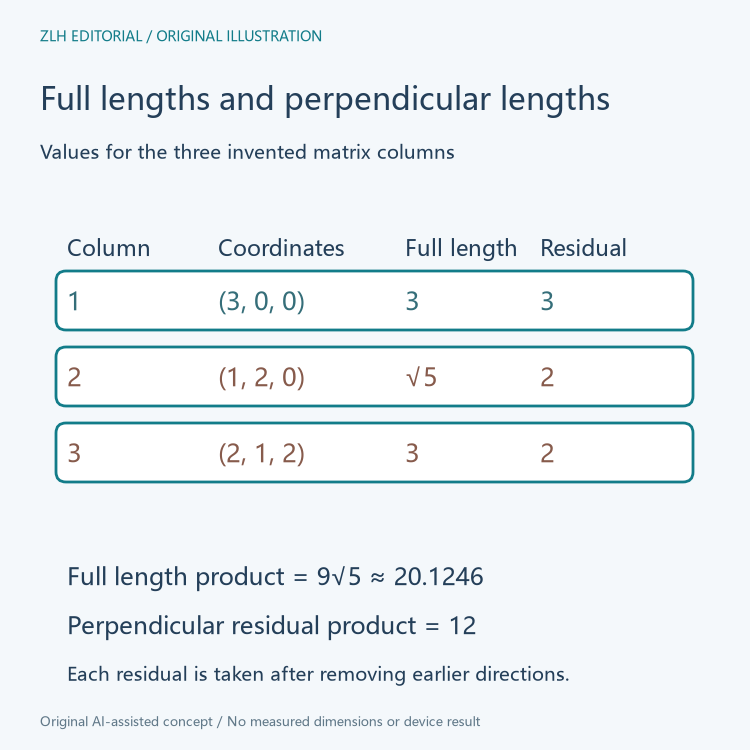
Calculate each Euclidean length from the sum of squared coordinates. The lengths are 3, √5 and 3, respectively. The third vector has length √(4 + 1 + 4) = 3. The product of the lengths is 9√5, or about 20.1246. The Hadamard bound states that the absolute determinant is at most this value. A determinant of 12 therefore satisfies it with room to spare. The individual column lengths include components that lie in directions already spanned by earlier columns.
See where the volume is lost relative to the product
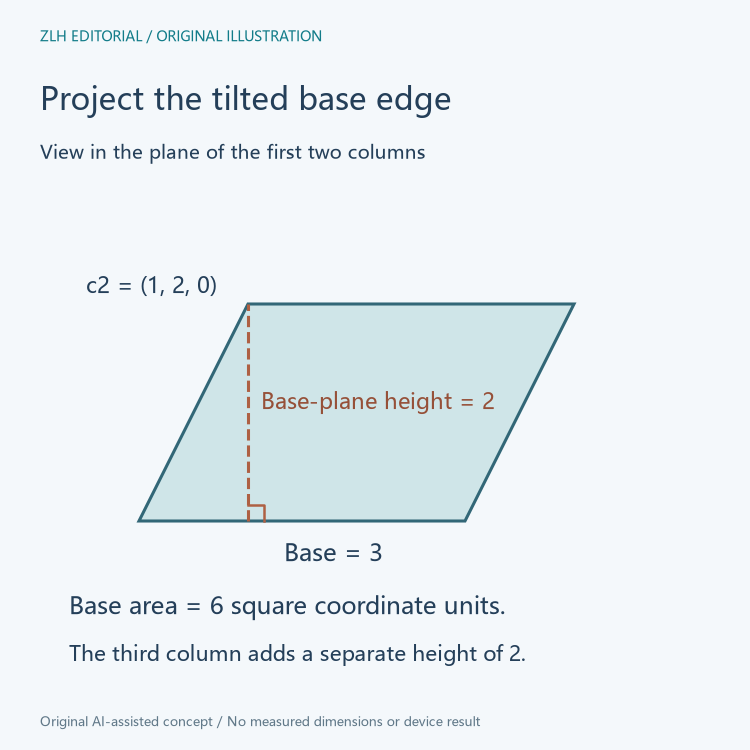
The first column points along the x axis. Subtract one third of it from c2, leaving (0, 2, 0). This drops the projection that lies along the first column, while keeping the second column's component perpendicular to it. The length of the base direction that contributes to the parallelepiped is two. The base area is three times two, or six square coordinate units.
Now subtract two thirds of the first column and half of the residual second column from c3. What remains is (0, 0, 2), perpendicular to the base plane. Its length gives the height of two. The volume from base area and perpendicular height is 12, agreeing with the triangular determinant. Each subtraction adds a multiple of one matrix column to another and preserves the determinant. The residual vectors happen to align with the coordinate axes in this example.
Compare with a set of orthogonal columns of the same lengths
Make a second matrix with columns (3, 0, 0), (0, √5, 0) and (0, 0, 3). Its three original lengths still match the first matrix, but the columns are orthogonal. In this case the full lengths multiply to the exact absolute determinant 9√5. There is no projection to remove. For a set of nonzero independent columns, equality in the Hadamard bound requires mutual orthogonality. If a column is zero then both sides of the inequality are zero without requiring meaningful directions for all vectors.
The first matrix and the orthogonal comparison have the same upper bound because the separate lengths were retained. The difference is how those directions meet. In two dimensions the analogous comparison is between the product of two edge lengths and the area those two edges span. That area uses the perpendicular component of one of them, which is smaller than its full length whenever their angle is different from a right angle and the two directions are independent.
Choose the check that matches the available matrix information
Column lengths by themselves provide a bound, while the arrangement of directions is needed for an exact determinant. In a computational review, save whether rows or columns were used and which norm was applied. Transposing the matrix swaps the two roles and preserves the determinant, but the product of row lengths may differ from the product of column lengths. Each gives a separate valid Euclidean bound.
For the first example, the rows are (3, 1, 2), (0, 2, 1) and (0, 0, 2). Their respective lengths are √14, √5 and 2. Their product is 2√70, about 16.7332, which is smaller than the column product and greater than 12. With all nine entries available, comparing these two products gives a tighter upper bound. This comparison uses the same matrix and the same Euclidean norm. It demonstrates how the choice of grouping changes the bound while the determinant is fixed.
Exchanging two columns is another simple verification. Their product of lengths is unaffected because it uses the same three factors. The signed determinant reverses, and the absolute determinant remains 12. This distinction matters when a sign records orientation but the bound is used to check a volume.
The example is exact before rounding. Evaluating the length product and the orthogonal residual product separately makes it possible to identify whether a numerical discrepancy is caused by vector lengths, by the determinant calculation, or by confusing the upper bound with an equality. Related reading is available in the site's technical articles and industry resources.
Sources include Friedland’s statement of the Hadamard determinantal inequality and the IIT Madras volume argument using orthogonalization.