

Camera Firmware Records: Reported and Recommended Versions
2026-11-05
Camera Firmware Records: Reported and Recommended Versions
Firmware Records in a robot camera catalogue need to distinguish the firmware reported for the device from a recommended firmware reference. RealSense's camera-information enumeration gives these separate names. Collapsing them into one version column can make a recommendation look like an observation of the delivered camera. This article reads the official SDK repository through a fictional inventory appendix. It queries no device, names no currently preferred version and supplies no update procedure.
Keep the two firmware-information names visible
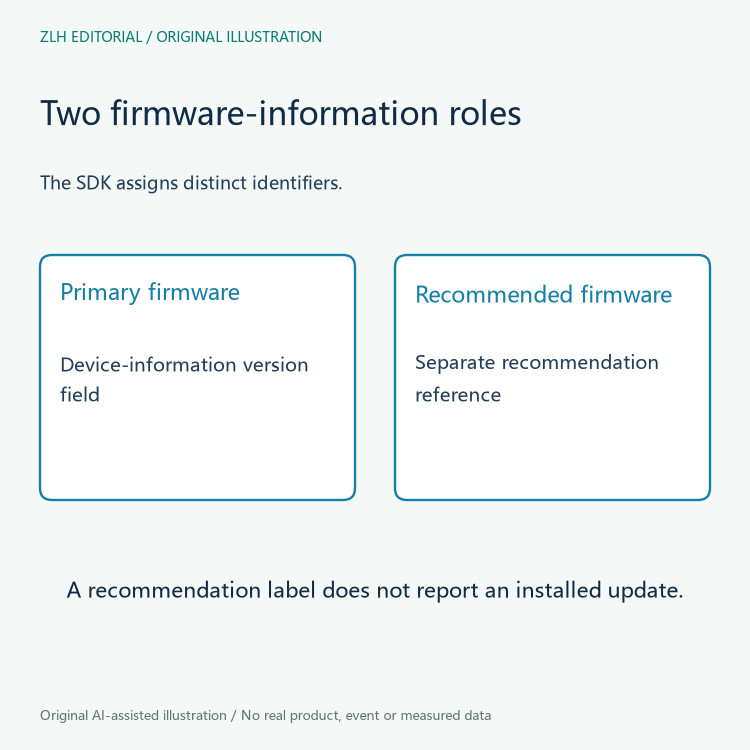
The official RealSense sensor header defines RS2_CAMERA_INFO_FIRMWARE_VERSION as the primary firmware version and RS2_CAMERA_INFO_RECOMMENDED_FIRMWARE_VERSION as the recommended firmware version. These are separate information identifiers, even though both concern firmware. Their exact identities should survive a catalogue translation or spreadsheet cleanup.
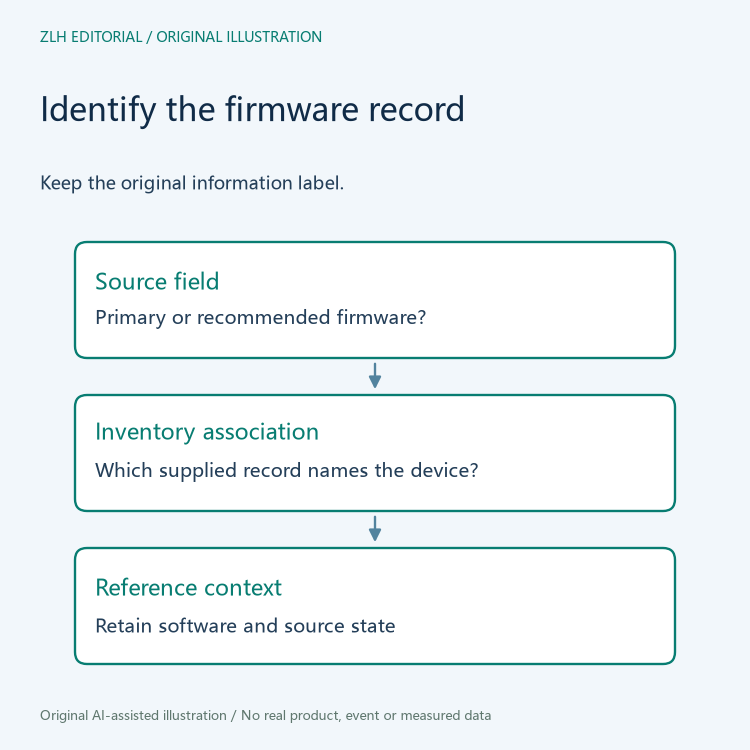
For a fictional robot-vision inventory, suppose an attached export has both labels but the catalogue retains only a field called firmware. The editor should ask which original identifier supplied that value. Similar-looking version strings would not resolve the question. The problem is the missing field association, rather than a demonstrated mismatch in the physical camera.
A recommended reference does not report an installed change
A recommendation identifies a reference role. It is not, by that label alone, a report that a device has been updated to that version. The primary firmware field and the recommendation can be recorded side by side with their source context instead of allowing one to silently replace the other.
The hypothetical catalogue has no actual version values. This article therefore finds neither a match nor a mismatch. It also makes no claim that the inspected enum describes every internal component's firmware. The source calls the first field primary firmware, and the catalogue should preserve that wording rather than promote it to an exhaustive software inventory.
Read recommendations with their software combination
The official software support matrix says the project recommends particular combinations of firmware and software that it has tested. A recommendation is consequently not just a free-standing firmware number detached from the software context. The contributor should identify which recommendation account accompanies the catalogue record.
The same document describes a release process involving validation cycles and release promotion. That general explanation should not become a claim that an unknown delivered camera passed a particular deployment's acceptance process. Reading the project document does not inspect the camera, identify the application or supply the missing test records.
The matrix also contains platform descriptions. They belong to that repository document's stated scope; this article does not expand them into an up-to-date compatibility table for every operating system or camera. A catalogue should retain its applicable SDK and source state instead of treating a general paragraph as a universal equipment assurance.
Preserve where the inventory value came from
A catalogue entry should keep the delivered object's identity, the original information label and the supplied record context together. The enum tells the reader what the identifier means. It does not demonstrate that a contributor's screenshot or handwritten note actually came from the listed camera.
If a contributor supplies only a recommendation page, record that material as a recommendation source. If it supplies a retained device-information export, identify the export and its field labels. The reviewer should not invent a device observation to complete a blank row, or assume the recommendation page records the installed primary firmware.
Separate a caption correction from an equipment update
Suppose the fictional editor discovers that a recommended-version value was copied into a column described as installed firmware. Correcting the caption or moving the value into its proper reference field is an editorial change. It does not change the camera's firmware and should not be described as a completed equipment update.
A later device-information record needs its own identity and relationship to the catalogue entry. Without that material, the article cannot say what changed on the camera or when. It offers no download, flashing command, update tool sequence or recommendation that a rental, repair or production device should be altered.
Publish the two roles with a bounded conclusion
A useful database note can identify the reported primary-firmware field, the separate recommendation field and the applicable software-source context. It should leave any unresolved association visible. That is more informative than a single firmware checked label whose reader cannot trace the original information object.
The cited master-branch files were read on November 5, 2026 and may change; they are not a fixed release specification. The original diagrams contain no camera serial numbers, version values or device screenshots. Related reading appears in the robot equipment catalogue category and technical reference category. Firmware Records remain clearer when reported device information and a recommended reference keep their separate documented roles.


