

JRDB-Pose3D News: A Person Track Is Not a Robot Model
2026-11-02
JRDB-Pose3D News: A Person Track Is Not a Robot Model
A robotics research page can mention a mobile platform, human bodies, tracking identifiers, and an estimation model in the same short description. A catalogue editor needs to know which object each label names. The 2026 JRDB-Pose3D material provides a useful example for a robot database that links to perception research. This article examines the project announcement and authors’ paper record on November 2, 2026. It does not download the dataset, identify any person, or assess a perception model’s performance.
The announcement and paper record have different publication contexts
The JRDB project page lists its JRDB-Pose3D release news on May 6, 2026. The authors’ JRDB-Pose3D paper record has a February 2026 submission context and describes multi-person pose and shape annotations collected from a mobile robotic platform. These are related records, but their dates should not be collapsed into one invented publication event.
The paper abstract also describes tracking identifiers associated with people over time. That statement helps identify what an annotation label refers to. It does not mean such an identifier is a hardware serial number or an identifier for the collecting robot’s product model.
Ask which entity owns the label
For a fictional catalogue exercise, imagine a record editor receiving a neutral description of a scene annotation. The description includes an anonymous track label and a reference to the collection platform. The editor must decide where each belongs before creating a database field.
A person track describes an annotation relationship across observations. A collection platform identifies the equipment context in which material was obtained. A robot model record describes a product or model entity. Those concepts can be connected in a catalogue without being treated as alternative names for the same thing.
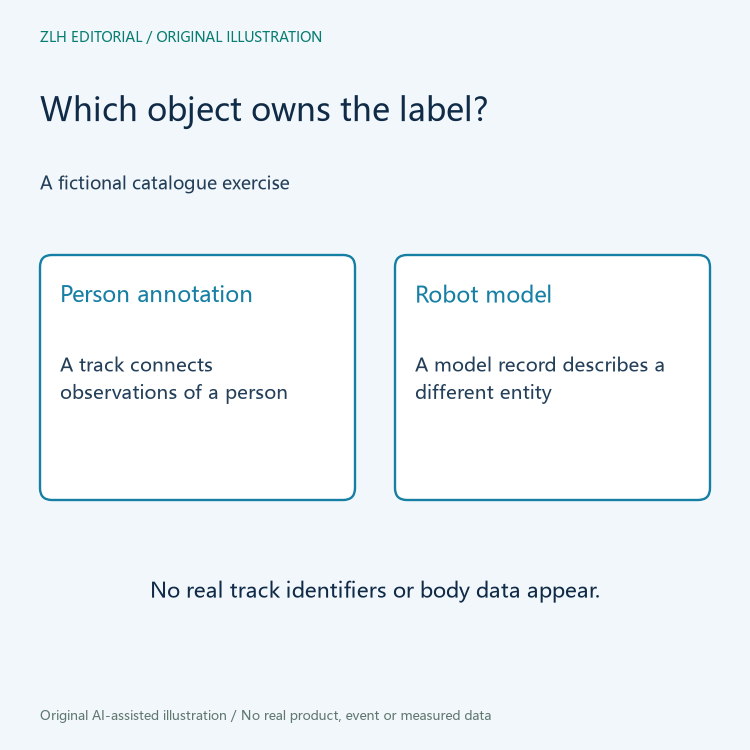
The example deliberately uses no real annotation values. Its purpose is to expose the naming question, not to show a genuine participant or imitate dataset content. A reader can understand the distinction from a relationship diagram without seeing photographs, body coordinates, or a fabricated tracking sequence.
Do not infer product capabilities from a dataset’s subject
A dataset collected with a robot platform can support research questions without becoming a product specification for that platform. The presence of pose annotations does not, by itself, tell a reader which functions an off-the-shelf robot performs or under which conditions a deployed system would work.
Similarly, a paper about an estimation task should not be copied into a catalogue as a tested capability of every model linked nearby. The editor should preserve the author’s research context and identify any product claim separately. This article makes no assessment of accuracy, robustness, or suitability for a particular environment.
In the fictional exercise, the catalogue might link the research record from a broader topic page. The link can be useful while remaining explicitly a research reference. It does not need to be promoted into a product feature merely to fit a database’s existing layout.
A database schema should leave room for the distinction
If a catalogue has only one generic “model identifier” field, it may encourage the editor to force different objects together. A better proposed design is to name the entity being described before selecting the field. The intended reader should be able to tell whether a record concerns hardware, a research task, or an annotation object.
This suggestion is an editorial model for the hypothetical exercise. It is not a claim that JRDB requires a particular external database schema. The actual project materials should remain the source for the dataset’s own definitions and access conditions.

A missing field can be recorded as a design question rather than filled with an unsuitable identifier. That allows the catalogue team to decide whether a new relationship is needed. Guessing an answer just to complete a form would make the record look finished while obscuring what it describes.
Keep research access and review status honest
Reading the public paper abstract and project news does not equal reviewing the underlying dataset. The catalogue should say which material was actually examined. The project’s stated access route should remain in place; an editor should not present restricted material as an unrestricted local download.
If an authorized research review is later performed, it can have its own record of the actual files, task, and method. This article supplies none of those results. It focuses on a smaller but important question: whether an identifier has been attached to the right kind of object.
Other object-definition topics are available in our robot database section, with further reading in the topic directory. Both illustrations are original conceptual aids. They contain no participant information or copied annotations, and they do not turn a research track into a robot product identity.


