

Robot Catalogue Practice: Check the Connection Context
2026-11-02
Robot Catalogue Practice: Check the Connection Context
A robot catalogue can describe a relationship between a model entry and its attachments without showing whether a particular database connection enforces that relationship. This practical exercise uses an imaginary training catalogue to separate those questions. It is a proposed learning method, not a report of an existing database problem. No catalogue was opened, no records were changed, and no robot specifications appear in the example.
Draw the intended relationship before discussing a setting
For the exercise, imagine that one table describes model entries and another describes attachments associated with those entries. The first task is to explain what the association means. A learner should identify which entry an attachment refers to, rather than infer the relationship from similar names.
This drawing should remain a conceptual aid. It is not a copy of a real schema and does not establish that an attachment describes the correct physical robot. The relationship question concerns the catalogue arrangement; the accuracy of the source material would require a separate review.
Ask a second learner to explain the relationship without using database terminology. If the explanation changes between readers, clarify the intended association before discussing implementation. A technical setting cannot decide which business relationship the catalogue owner actually wants.
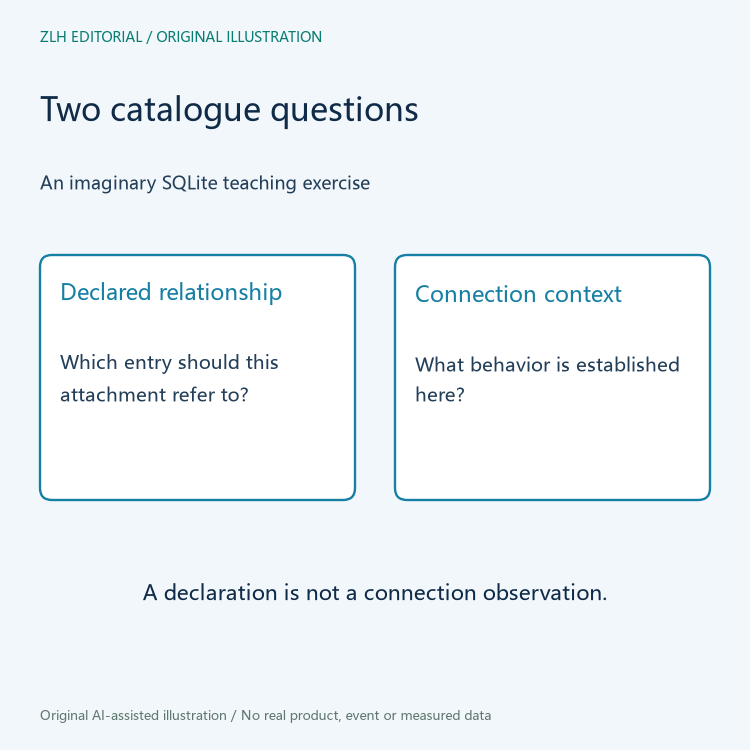
Keep a declaration separate from a connection observation
The SQLite foreign-key documentation explains that enforcement is connection-specific. A relationship declared in a schema and the state of a particular connection therefore deserve separate attention. The exercise should not assume a setting from a familiar application name or an earlier session.
In a prepared, isolated training environment, an instructor could ask learners to identify the connection about which they intend to make a statement. The learner should be able to say why information about that connection is relevant to the exercise. No production connection is part of this article.
If the instructor has not supplied that context, retain the question. Do not copy a result from a documentation example and present it as the local state. A plan to inspect a setting is useful, but it should remain a plan until the observation actually occurs.
Read the purpose of a query before interpreting its answer
The SQLite PRAGMA reference describes queries and controls for SQLite-specific internal information. A training note should identify the particular question being asked instead of treating every PRAGMA operation as the same kind of check. The intended scope matters before any result is interpreted.
For this imaginary catalogue, distinguish a question about connection behavior from a question about records already present. One concerns how a relationship is handled in a stated context; the other concerns the material being examined. Neither should be silently substituted for the other.
The article provides no query transcript and claims no clean report. If an instructor later prepares an actual exercise, its observations should name the environment and the question each observation answers. Learners should not fill a missing answer with a generic success label.
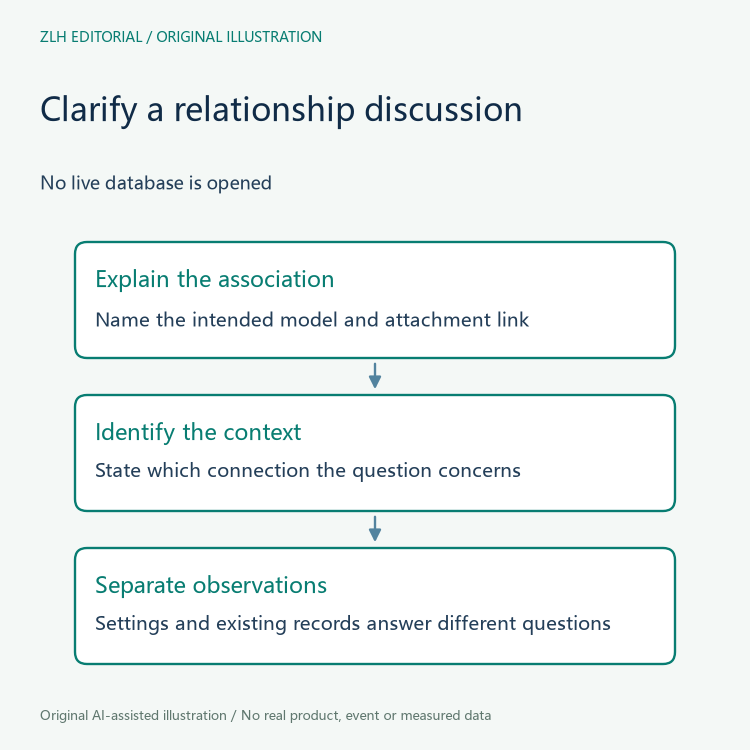
Use a training copy to investigate a disagreement
Suppose two fictional learners describe the same association differently. One may be discussing the schema while the other is discussing a connection. Before calling the accounts contradictory, ask them to identify their objects. Clarifying the level may reveal that they were answering different questions.
If a genuine disagreement remains in an authorized classroom exercise, retain the prepared material and ask the instructor to explain it. The response should remain proportionate to what was observed. This article does not propose changing live tables, disabling controls, or deleting attachments to make a report appear clean.
A discrepancy also does not identify its cause by itself. The catalogue arrangement, the chosen observation, and the exercise context may need further explanation. Without actual evidence, it would be misleading to attribute the issue to a particular application or supplier.
Describe the limited result the exercise would support
A useful training summary could explain the intended association, the connection to which a statement applies, and the difference between settings and record observations. It should leave any unperformed step visible. This gives the next learner a clear point from which to continue.
Even a completed technical exercise would not establish that a model entry is authentic, that an attachment is current, or that a robot is suitable for use. Those are further claims about different evidence. Keeping them separate makes the catalogue discussion more precise.
Related methods appear in our robot model data section, with more reading in the article directory. Both original illustrations are conceptual teaching aids. They contain no actual schema, connection output, customer records, or database assessment result.


