

Robot Catalogue Acceptance: Locate the Exact JSON Value
2026-11-02
Robot Catalogue Acceptance: Locate the Exact JSON Value
A JSON Pointer can identify a value inside a JSON document, but a pointer string alone does not establish which catalogue document a reviewer should inspect. A robot-data supplier may use such references to explain where a delivered field appears. Before accepting that explanation, the buyer needs the document context and the reference mechanism. This article proposes a document-review checklist. It evaluates no pointer, retrieves no catalogue, and provides no real robot specifications.
Accept the document identity before the internal location
Ask the supplier which delivered document the reference concerns. A position within one revision may not identify the same content in another. Keep the source document and the stated revision beside the reference rather than copy the location into a standalone spreadsheet.
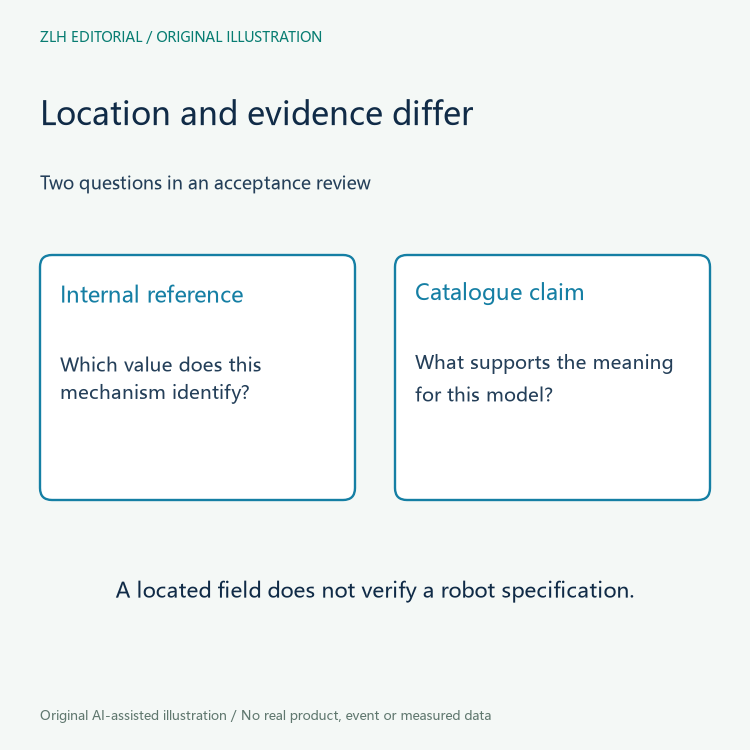
The receiving reviewer should also know the intended question. Locating a supplied field is different from confirming that the field describes the purchased model. The reference can support navigation within a document without establishing the truth or applicability of its contents.
Include the supplier’s explanation of what should be reached: a whole prepared object, an item in a collection, or a particular member value. These are different review targets. A receiver who expects one while the supplier means another can disagree even before the reference is interpreted. Resolve that question in the handover note rather than infer it from the result that looks most convenient.
For the hypothetical handover, leave the actual document unspecified until the supplier supplies it. There is no need to invent a model identifier or a plausible parameter value. An unresolved reference is a useful acceptance question, rather than a reason to manufacture a complete-looking catalogue entry.

Read pointer tokens as structure rather than search words
RFC 6901 describes evaluation beginning at the root of a JSON document and proceeding through reference tokens in sequence. The mechanism is not a free-text search for a familiar field name. A supplier should explain the relevant structural location.
The specification also defines escaping within tokens. For a prepared review, ask whether the supplier preserved the actual reference representation. Do not rewrite punctuation merely to make the string look like an ordinary file path. The notation belongs to its own defined mechanism.
This article supplies no token example or executed result. In a later authorized inspection, the reviewer should record the actual document and the reference used. A value found by visually searching a page should not be described as the output of a pointer evaluation that never occurred.
Keep URI-fragment context distinct from a plain pointer
The RFC includes a URI-fragment representation of JSON Pointer. A delivery note should identify which form it uses, rather than treat every string following a hash sign as automatically meaningful in the same way. The surrounding resource context matters.
RFC 3986 explains that fragment semantics depend on the representation’s media type. That is a reason to retain the applicable representation context. A fragment-looking suffix on an arbitrary address does not, by itself, prove that the receiving system interprets it as a JSON Pointer.
Ask the supplier to describe the actual consuming context and the intended representation. The buyer should not test guessed addresses or assume that a browser opening a resource has evaluated the internal reference. Those would be separate observations with their own scope.
Require the review record to preserve failure and ambiguity
A supplier may provide an actual evaluation record in a later acceptance activity. It should identify the input and result, including an unresolved location when appropriate. Do not replace an unsuccessful reference with a nearby value simply because it appears to match the expected meaning.
If repeated object names or another structural ambiguity affect the reference, ask the supplier to address the actual document. The buyer should not silently edit the source and then report that the original passed. A correction needs a distinct revision and a renewed check.
The present checklist performs none of these activities. It describes what a real record should make understandable. No catalogue parser, remote service, or production database is operated, and no acceptance outcome is fabricated.
Close the reference task without widening the conclusion
A useful handover lets another reviewer identify the source document, the reference form, the structural location, and the observation actually made. If one is missing, keep it as an open item. Clear limits help the supplier answer a focused question.
Even a successfully located value would not establish a robot’s payload, configuration, condition, or suitability. Those claims need appropriate evidence about the described object. Document navigation should remain one part of the catalogue review.
Related material appears in our robot catalogue section and the article directory. Both original illustrations explain reference roles only, with no actual pointer, model record, resolved value, or software execution output.


