

Robot Catalogue Maintenance: Investigate Expanded Joins
2026-11-02
Robot Catalogue Maintenance: Investigate Expanded Joins
A catalogue merge can produce more rows than a receiving editor expected without establishing that new robot models have appeared. The first maintenance task is to preserve the inputs and the operation that produced the view. This article develops a proposed investigation of that symptom. It runs no merge, reports no real catalogue totals, and does not identify a fault in an existing publishing system.
Retain the unexpected view before changing the inputs
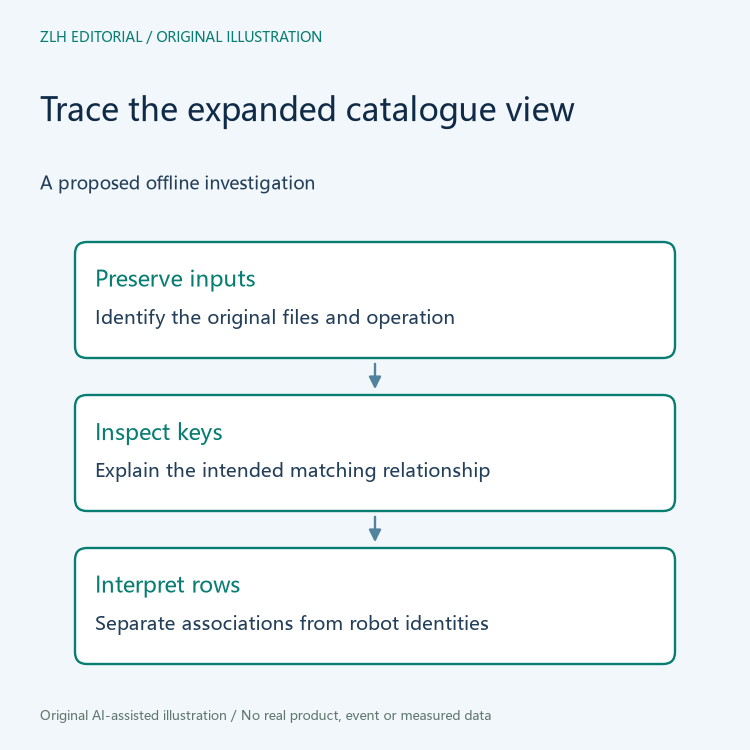
Record which delivered files and which transformation the report concerns. Ask whether the observation came from a preview, an exported table, or a persistent database view. These representations can belong to the same workflow without containing identical rows. The maintenance note should identify the object actually observed.
Keep the original files distinct from working copies. Removing repeated-looking rows before understanding their role can destroy the evidence needed to explain the expansion. A repeated model label might describe several attachments or source statements. Its appearance alone does not establish that it is an erroneous duplicate.
Write the intended relationship in ordinary language. Was each catalogue entry supposed to match one supplier record, several documents, or another agreed structure? That question gives the investigation a target. Without it, a smaller output may look reassuring while still representing the wrong association. Ask who owns that relationship definition and how a receiving editor can obtain the version applicable to the actual export under review.
Examine multiplicity at the actual merge keys
The official pandas merging guide explains that when a key combination occurs repeatedly in both inputs, a many-to-many join creates the Cartesian product of the associated data. The practical maintenance question is which key combinations the delivered operation actually used.
Ask the author to distinguish the visible model label from the complete merge key. A display column can look unique while a selected combination is not, or the reverse. The receiving editor should not infer the operation from the final column arrangement. Request the actual configuration and relevant source definitions.
This documented behavior offers a possible line of investigation, not a diagnosis of the hypothetical symptom. No source records are provided here. A real maintenance conclusion would need evidence showing which associations produced the observed view.
Check the declared relationship rather than merely allowing it
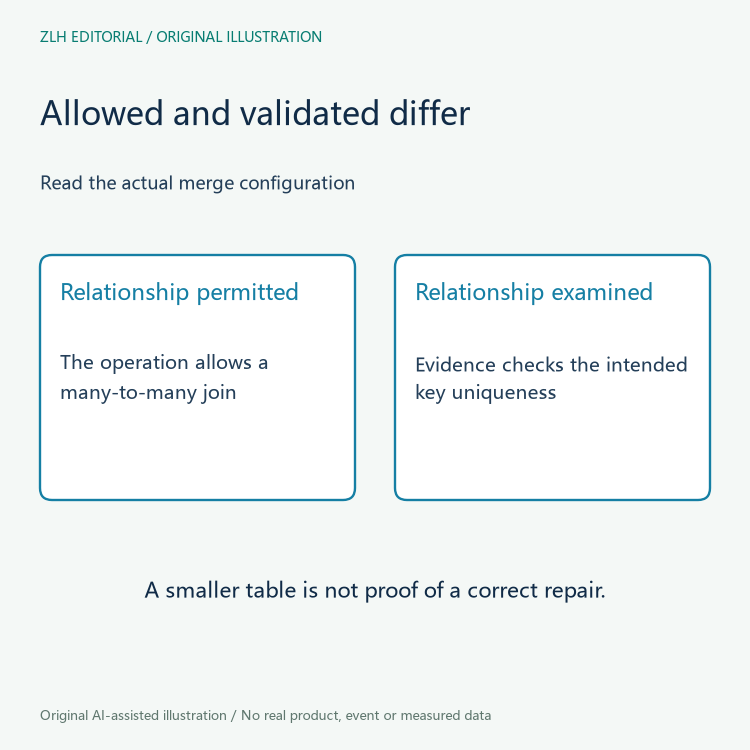
The pandas merge reference describes validation options for checking key uniqueness in the relevant inputs. It also states that the many-to-many option permits that relationship without performing those uniqueness checks. A permissive option should not be reported as proof that the business relationship was validated.
Ask which relationship the author intended to check and which actual result was obtained. Retain an exception or an unresolved condition rather than changing the option solely to suppress a complaint. A maintenance record should explain why the revised operation fits the intended catalogue structure.
The same reference warns that null keys on both sides can match in pandas, unlike usual SQL join behavior. If that context is relevant, preserve the actual missing-key handling. Do not silently fill missing identifiers or claim that an empty label represents a known robot model.
Separate row expansion from new catalogue meaning
An output row reflects the association produced by the transformation. It is not automatically a distinct physical robot, a new model, or an independently confirmed specification. The maintenance reviewer needs the catalogue’s data model before interpreting the expanded table as an equipment count.
If a later investigation finds an unintended relationship, identify the affected inputs and the proposed correction. Avoid deleting material based on a visual resemblance alone. The responsible data owner should explain which distinctions the catalogue must preserve.
Keep the repair proposal separate from a tested outcome
A proposed change should name the intended relationship and the evidence that a receiving review would examine. The plan might involve clarifying keys or changing an export transformation. This article prescribes no production change and reports no executed repair.
In a later authorized check, retain the original and revised representations and explain the comparison performed. A smaller row count alone would not establish correctness. The reviewer must still understand which associations remain and whether they match the agreed catalogue purpose.
Close with an attributable maintenance explanation
The final record should connect the symptom, source representations, merge keys, multiplicity, and actual observations. Where the cause remains unknown, say so. Another editor should be able to follow the explanation without relying on an undocumented manual deletion.
More methods appear in our robot catalogue section and the article directory. Both original illustrations show investigation relationships only, without actual rows, model quantities, computed joins, or completed corrective actions.


