

NumPy October Fix: Read a Catalogue Fill Value Carefully
2026-11-03
NumPy October Fix: Read a Catalogue Fill Value Carefully
A robot catalogue export may contain a value that helps software represent an unavailable entry without supplying a new fact about a robot. That distinction becomes important when the data-processing environment changes. NumPy's October maintenance release includes a correction involving masked arrays and their fill values. For catalogue readers, the useful question is whether a displayed number came from source information or from the rules used to represent an array.
The October correction concerns inherited representation
The NumPy 2.5.4 release notes, dated October 10, 2026, explain that an inherited fill value which cannot be represented in a new data type is reset to that type's default. They distinguish this from a value explicitly supplied by the user, which remains subject to validation. The change concerns the handling of array metadata during a type change; it does not establish a new physical quantity for a robot.
The linked upstream correction explains the problem through the behavior of inherited fill values and conversion. Its examples are development evidence for the library change. This article does not repeat them as catalogue observations or claim that a particular data supplier uses NumPy. The relevance to catalogue work is an editorial inference about how to ask for the origin of displayed output.
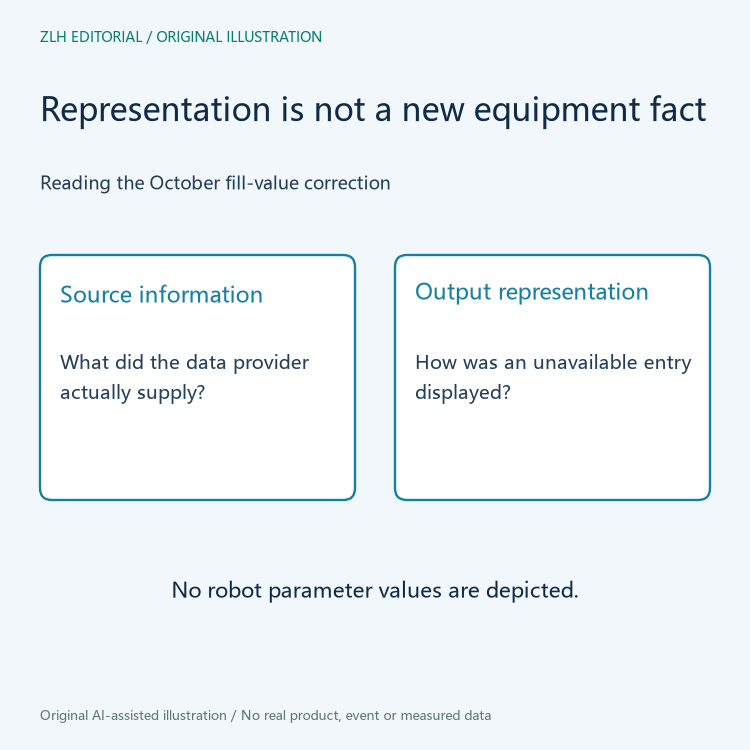
Ask where the visible value entered the record
Consider an illustrative review in which a catalogue recipient sees a large number where the supplier says no equipment measurement was available. Before interpreting the number as a limit, rating or sensor reading, the recipient can ask how that field was produced. The answer should identify the source entry and any representation step. This example is deliberately hypothetical and supplies no actual model name, parameter or measurement.
That inquiry is different from asking whether the table opened successfully. A readable output can still leave the origin of one value unclear. The person responsible for the data can explain whether it was supplied, calculated, inserted for presentation or inherited through processing. The reviewer should retain that explanation with the relevant field, rather than relying on a visual pattern shared by other rows.
If the explanation is unavailable, the field should remain a question. Do not derive an equipment capability by guessing what a placeholder probably means. A catalogue can tell readers that clarification is pending without inventing a replacement parameter. This preserves the distinction between an incomplete equipment record and a convenient software representation of that record.
A type change can matter even when the source did not change
The release item suggests a useful comparison question for teams investigating a changed export: what changed in the processing conditions? The source file, data type and formatting context should be identifiable before the team attributes a difference to the supplier's equipment information. This does not mean every changed value is a library issue. It means that a conclusion should name the evidence supporting its explanation.
When comparing two outputs, keep both connected to the inputs and environment descriptions that produced them. If only an output is available, say that the comparison is limited. The library's release note may help formulate a hypothesis, but it cannot reconstruct a processing history that nobody recorded. This publication has not converted an array, regenerated an export or investigated a live catalogue.

Explain representation choices to downstream readers
A catalogue editor can help recipients by giving representation conventions a visible place in the accompanying documentation. The explanation should make clear how unavailable information is shown and who can answer questions about it. A downstream user should not need familiarity with a particular numerical library to understand that a display value is not an equipment observation. Keep the explanation tied to the edition actually delivered.
Documentation should also identify the limits of any conversion statement. Knowing that a processing step used a particular type does not prove that every field was interpreted correctly. Units, intended meanings and source authority require their own information. An inherited fill-value correction should not be enlarged into a general claim that a catalogue has been repaired or validated end to end.
What this maintenance news adds to catalogue reading
The October correction highlights a specific place where representation metadata can change. The practical editorial lesson is to ask for a value's path into the visible output before treating it as a newly supplied fact. That approach keeps the software news useful while leaving real catalogue conclusions attached to real source material and observations.
The drawings are original conceptual explanations, not screenshots of NumPy output or robot specifications. Further reading appears in our robot model data collection and article directory. Where a record lacks evidence, an explicit request for clarification is more informative than a plausible number with no established origin.


