

Robot Battery Catalogue Acceptance: Energy and Runtime
2026-11-04
Robot Battery Catalogue Acceptance: Energy and Runtime
A robot battery catalogue can display a capacity and a runtime on the same line, but those fields answer different questions. Energy expressed in watt-hours describes an energy quantity. A duration expressed in minutes describes time under the conditions attached to that statement. Accepting the record requires keeping both meanings visible, together with the source context. This article examines two official Spot references as a documentation example. It does not test a battery, estimate remaining life or promise a duration for an offered robot.
Define the catalogue fields before selecting the numbers
A submission should identify whether a value describes battery energy, a manufacturer's runtime statement or an observed duration from an identified trial. Those entries can coexist in a database, but should not occupy one interchangeable field called battery performance. A buyer needs to know which question each value can answer and where its supporting information is located.
Consider a hypothetical catalogue import in which an editor receives one battery energy value and an average runtime statement. The importer should preserve the original quantities rather than produce a new runtime estimate from an unspecified load. No actual import error is reported here. The example explains why a source-to-field mapping belongs in the acceptance package, before comparisons between robots are published.
Keep the manufacturer's runtime qualification beside the field
The official Spot product page, inspected for this reading, presents battery capacity and average runtime as separate specifications. The runtime entry carries a qualification that it may vary with payloads and environmental factors. A catalogue should retain that qualification in a field note or directly associated description rather than displaying the duration as a guaranteed result for every configuration.
This is a source-reading conclusion, not an independent evaluation of the manufacturer's figure. The public page does not document the condition of an individual battery being offered by a distributor. Nor does its runtime entry establish that a particular inspection route can be completed on one charge. Those procurement questions need evidence that identifies the actual equipment and the intended acceptance activity.
The field label also matters when information is shortened for a search result or comparison card. Removing average while leaving only a number can change the apparent promise. Ask whether the qualification remains accessible in every view that reuses the field. An accurate long description does not automatically resolve a compressed listing that presents a stronger statement.
Preserve the context when official references differ
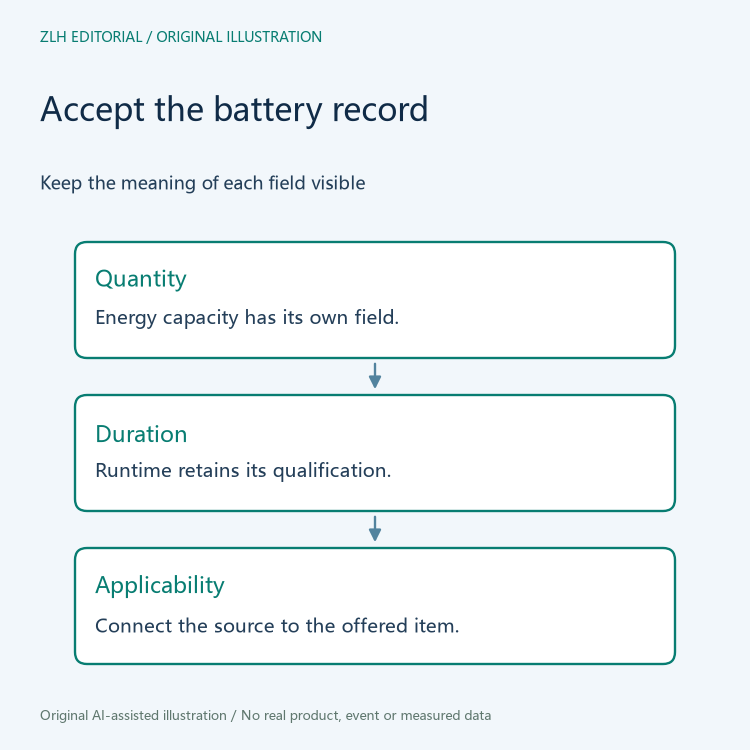
The official About Spot page in the Spot 5.2.0 documentation identifies its specification table's robot type as Spot Gamma. Its power table supplies a battery capacity and a typical runtime. At the time of this reading, its energy value differs from the value displayed on the public product page. The responsible database action is to preserve the two source contexts and request applicability information for the offered unit.
Do not silently take energy from one table and duration from another to create a supposedly more complete specification. The two inspected pages do not establish that every listed value applies to the same delivered battery. They also do not provide a complete explanation of the discrepancy. A catalogue editor should not invent a hardware revision history, declare one source erroneous or infer a replacement relationship without further evidence.
A practical acceptance note can identify each URL, its documentation context, the relevant field and the date inspected. Retain an unresolved-applicability status if the supplier has not connected the offered item to the source. This makes a real uncertainty visible without converting it into a claim that the equipment is defective. The issue concerns the evidence supporting a catalogue entry.
Separate a published duration from a local observation
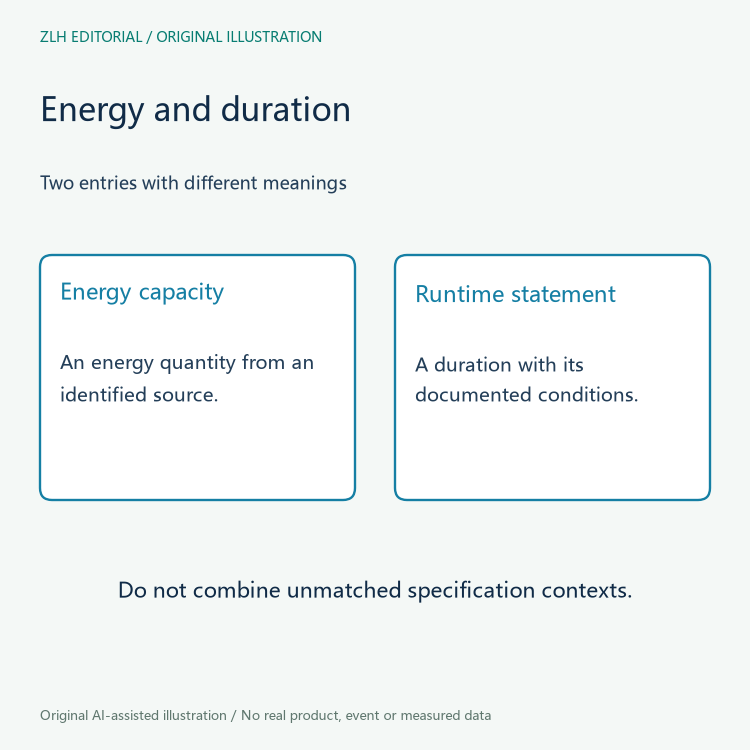
If a supplier delivers a runtime demonstration record, catalogue it as a different evidence item. The record should describe what equipment and activity it concerns, what counted as the beginning and end, and what relevant conditions were retained. These questions define the observation being offered. They do not prescribe a robot operation, a battery discharge procedure or an acceptance threshold.
A demonstration duration should not replace the manufacturer's general specification without a clear change of field meaning. Conversely, a manufacturer's duration should not be copied into a column labelled measured acceptance result. A blank observation field remains blank until an actual authorized observation exists. Data entry should preserve the distinction even when the two numbers happen to look similar.
Accept the relationship between each value and its evidence
The recipient can close the catalogue task when the energy field, runtime statement, qualification and applicability context can each be traced to their supporting material. If the offered battery has not been identified sufficiently, record that question explicitly. Approval of a source mapping does not establish battery health or fitness for a proposed deployment.
The original diagrams explain field relationships without illustrating a real battery or plotting an invented discharge curve. Further context is available in the robot model data collection and the article directory. A useful robot battery catalogue helps readers find the right evidence by preserving quantity, duration and source context throughout every displayed version of the record.


