

Robot Joint Range Records: A Turn Is Not Unlimited Motion
2026-11-04
Robot Joint Range Records: A Turn Is Not Unlimited Motion
A robot joint range can cover a complete turn while still having finite limits. A catalogue revision should not replace that description with unlimited rotation simply because a degree value looks familiar. The source's lower and upper bounds and a model's continuous-joint declaration describe different things. This article reads a UR20 specification alongside an official ROS URDF tutorial. It does not command a joint, inspect an installed model or determine whether a proposed movement is permissible.
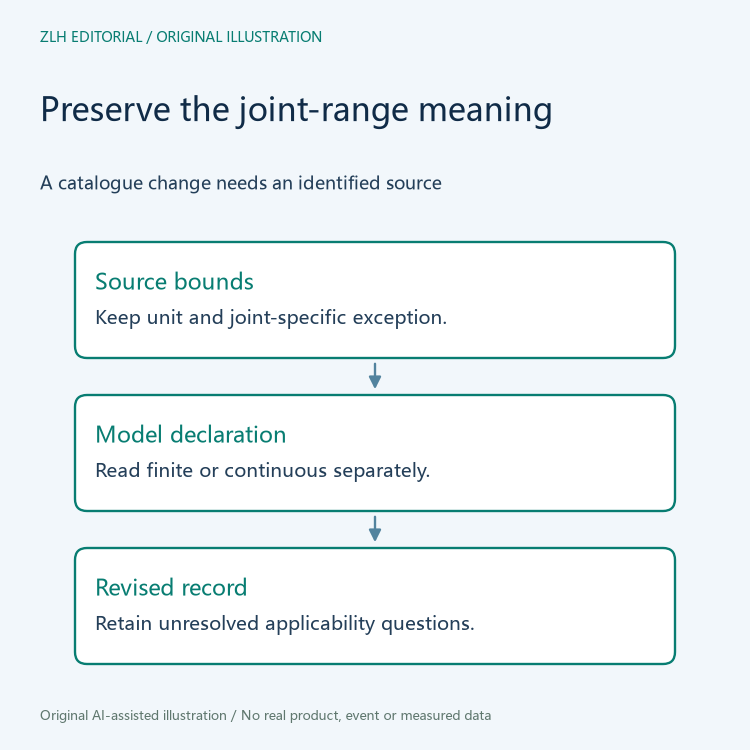
Preserve the joint-specific statement being revised
Start the maintenance record with the catalogue field, the source passage and the joint to which the statement applies. A broad column called rotation can conceal whether the author means a position range, a speed or a modeling type. The recipient should resolve that meaning before editing the value or expanding its wording.
For a hypothetical revision, imagine an editor changing a finite angle-range entry to continuous because the specification includes a full-turn value. The reviewer needs to ask whether the source actually removed the bounds. This fictional example is a catalogue-reading problem. It does not describe a real import error or identify any particular deployed robot model as incorrect.
Read the manufacturer's bounds and exceptions together
The official UR20 technical specification in the SW5.26 documentation gives a joint-range statement with an exception for the elbow. Its angular ranges are bounded statements, with the unit attached. A catalogue should preserve the exception rather than copying one general value across every joint.
The source-to-field mapping should name the individual joint or the exact group covered by a shared statement. When a table contains an exception, retain both the general rule and the exceptional object in the revision note. Otherwise an automated import may leave a plausible-looking value in every row while losing the very qualification that distinguishes one joint from the others.
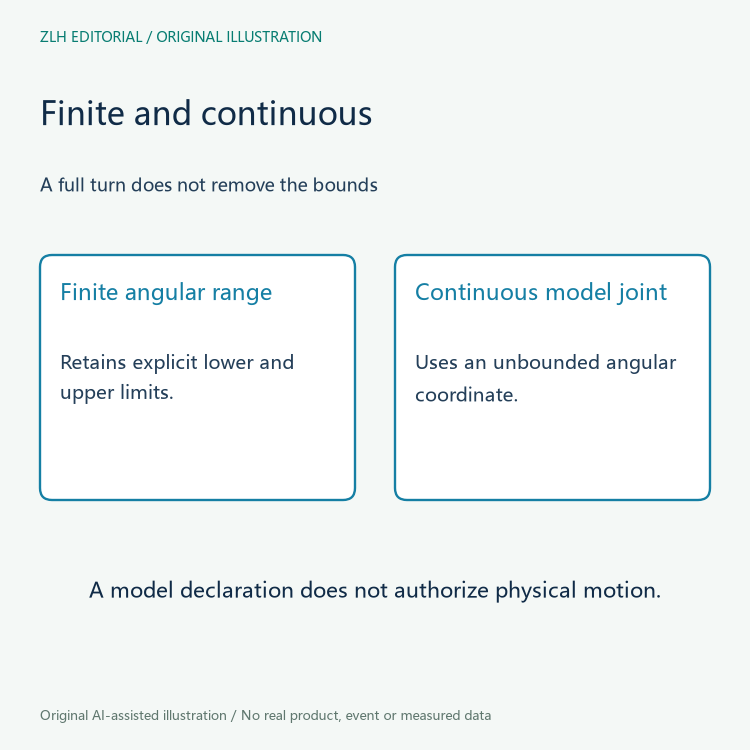
A finite interval does not become unbounded because it contains an angle equivalent to a full rotation. The relevant documentation still supplies limits. Do not erase a plus-or-minus sign, a joint-specific exception or the surrounding label when shortening the entry for a comparison card. Such changes can alter the meaning of the field.
The specification is a product reference, not an observation of a specific unit's current state. It does not establish the contents of an unknown simulation model or the suitability of a motion in an actual workcell. A catalogue editor can quote the applicable product statement while leaving installation-specific questions with their own evidence.
Read continuous as a particular model declaration
The official Jazzy tutorial on building a movable URDF robot model distinguishes continuous and revolute joints in its teaching example. The continuous example permits an unbounded angular coordinate, whereas the revolute example has explicit upper and lower limits. Preserve that modeling distinction rather than treating the two terms as synonyms.
The tutorial uses a demonstration model. It does not declare that a particular UR20 joint should use a particular URDF type. Connecting a manufacturer's physical specification to an actual model requires a reviewed model definition and applicable context. This article does not supply that mapping or validate a model package.
The tutorial also identifies radians for its revolute joint's limits. The manufacturer table and the model representation therefore need their unit conventions retained. A maintenance note should distinguish an actual documented conversion from a copied numeral. It should not silently paste degree values into a model-oriented field and assume the meaning is unchanged.
Keep representation questions separate from movement approval
A clearly defined angular interval helps explain catalogue data, but it does not answer every movement question. The surrounding system, attached equipment and actual task can introduce requirements outside a simple field. Neither linked source is a record of a tested trajectory for the reader's installation.
If a contributor reports that a displayed model wraps around an angle, retain the model and visualization context before drawing a physical conclusion. The observed display may be useful evidence about that representation. It should not be promoted into a claim that the actual hardware can rotate indefinitely. This article reports no such visualization observation.
Similarly, a model's continuous declaration should not be used as a shortcut for authorizing a real robot movement. The documentation-reading task concerns the meaning of a record. Any actual equipment activity needs its separate responsible process and applicable complete instructions.
Close the revision with the original meaning intact
A useful maintenance response identifies the field corrected, the bounds retained and any joint-specific exception restored. If model applicability or conversion details remain unresolved, list them explicitly. Do not mark the whole catalogue verified because one misleading unlimited-rotation label was removed.
The original diagrams show data relationships without a robot likeness or movement path. Related reading appears in the robot model data collection and the article directory. Keeping robot joint range attached to finite bounds, units and model context prevents a familiar angle from becoming an unsupported claim of unlimited motion.


