

Robot Camera FAQ: Calibration Size and ROI Records
2026-11-05
Robot Camera FAQ: Calibration Size and ROI Records
Calibration Size and the size of a captured image region can describe different things in a robot camera record. A catalogue editor who collapses them into one resolution field may hide how the supplied data should be interpreted. ROS CameraInfo provides a useful documented example of that distinction. This FAQ reads the Jazzy message definitions to frame a careful catalogue entry. It does not inspect a camera, alter calibration values or establish the resolution and performance of a real robot's imaging system.
What do CameraInfo height and width describe?
The official Jazzy CameraInfo definition places height and width among its calibration parameters and describes them as the image dimensions with which the camera was calibrated. It says these normally correspond to the full camera resolution in pixels. A catalogue entry should preserve that stated role rather than automatically assigning the values to every output image.
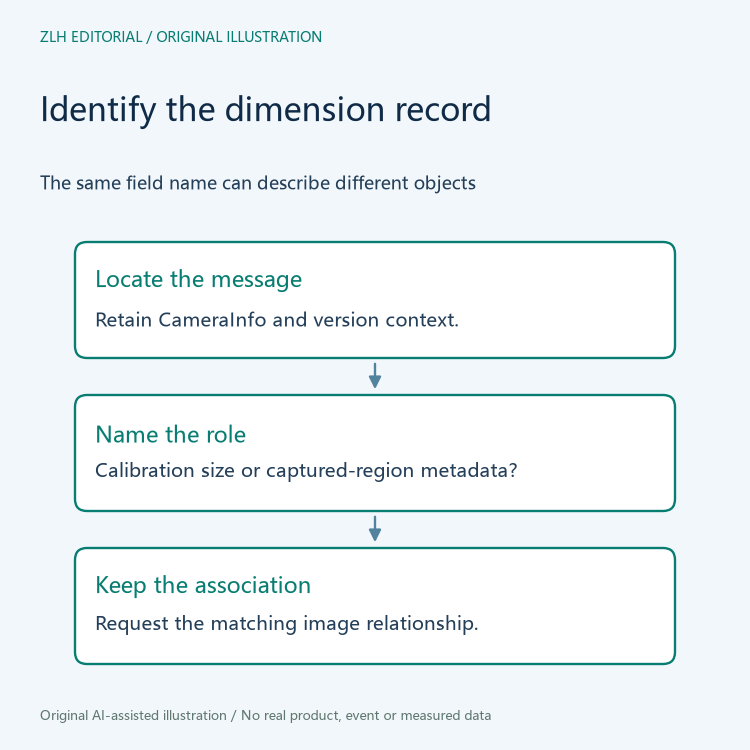
Keep the source field name and its containing message with the value. A plain spreadsheet column called width may refer to the calibration dimensions, an image message or a region of interest. The number alone cannot resolve that ambiguity. Request the original field identity if a supplier's export has flattened several camera records into one general table.
Consider a hypothetical robot catalogue with one camera entry and a sample image region. The editor receives calibration dimensions and a separate region description but labels both as sensor resolution. The useful correction is to give the two records their own roles and request their relationship. This invented example reports no camera defect, no actual dimensions and no failed calibration.
Where does the region of interest belong?
CameraInfo lists region of interest, or ROI, among operational parameters. Its comments describe ROI as a subwindow of full camera resolution, given in full-resolution unbinned image coordinates. The same definition separately discusses binning. These distinctions matter because an ROI record should not be interpreted merely by matching its numbers to the dimensions of a displayed preview.
The separate RegionOfInterest definition identifies offsets, height, width and a rectification-related flag. An editor should retain those field roles and the enclosing interface context. This is not a recommendation to compute new coordinates or change the camera configuration. It is a way to explain what the delivered metadata claims to describe.
Does a zero ROI always mean missing information?
No. CameraInfo explicitly gives an all-zero default ROI a meaning equivalent to full resolution. The separate RegionOfInterest comments also discuss zero height and width in a camera-setting context. Within these documented conventions, zero values can therefore carry an intended meaning. A catalogue import should not automatically replace them with unknown merely because zero looks implausible as an image dimension.
That does not make zero a universal convention for every camera format. Keep the interpretation tied to the cited message definition. If another supplier uses a different schema, read that schema before applying the same rule. A general missing-data cleanup policy should not erase a meaningful interface default, and a familiar default should not be imported into an unrelated record without support.

What if the image and metadata appear inconsistent?
First record which objects were compared. Identify the camera-info message, image record, region description and any known processing context. A mismatch in a summary table may reflect a lost relationship or an incomplete export; it does not by itself establish that the camera is miscalibrated. Keep the original materials while asking the responsible author to explain the association.
The cited definitions also include calibration matrices and other metadata, but their presence in a message is not a report of verified imaging accuracy. This FAQ does not calculate projections, rectify an image or judge calibration quality. A catalogue reading can identify the stated metadata roles while leaving the validity of actual calibration data to an appropriate assessment.
How should the catalogue preserve the distinction?
Use field descriptions that say whether a dimension belongs to calibration, a captured region or another supplied image record. Retain message version and source references so that a later editor can trace the interpretation. If the relationship is not provided, state that clearly rather than choosing the largest dimensions as the most favorable headline resolution.
A useful catalogue revision explains whether it corrects a field description or introduces new camera evidence. Relabeling an existing value does not mean that the camera was recalibrated. If the supplier later supplies a new calibration record, give that record its own identity and describe its relationship to the earlier entry.
These sources are the Jazzy sensor_msgs definitions, whose version is visible in the documentation. The original illustrations contain no camera frame or fabricated pixel array. The robot model data collection and article directory offer related reading. Keeping Calibration Size separate from ROI makes the catalogue more informative while preserving exactly what the supplied metadata can explain.


