

LaserScan Timing Fields: Scan Interval and Ray Spacing
2026-11-05
LaserScan Timing Fields: Scan Interval and Ray Spacing
LaserScan timing in a robot dataset has two different interval descriptions that should not collapse into one sampling-time column. The message defines time between measurements separately from time between scans. A database reader needs to preserve that distinction before interpreting an export or comparing collection descriptions. This article reads the ROS 2 Jazzy message definition through a hypothetical dataset appendix. It processes no scan, connects to no sensor and estimates no device performance.
What does the message say about measurement timing?
The official Jazzy LaserScan message page describes time_increment as the time between measurements, expressed in seconds. It separately identifies scan_time as the time between scans, also in seconds. Equal units do not make those fields interchangeable. The names distinguish the relationship being measured, and a dataset dictionary should retain both that relationship and the original field name.
In a hypothetical export, a column called interval could have been derived from either field. Ask the contributor which source field it represents and whether any transformation was performed. A unit label alone cannot answer that question. If the contributor cannot identify the mapping, keep the ambiguity visible. Choosing the field that happens to make a chart look familiar would replace missing provenance with an unsupported interpretation.
Where does the header timestamp fit?
The same definition identifies the header timestamp as the acquisition time of the first ray in the scan. The matching Jazzy source definition preserves that comment beside the header and keeps the two interval fields separate. Together, these source views locate the documented timing objects. They do not certify that an unknown recording populated every field correctly.
A database description should therefore avoid renaming the header stamp as the acquisition time of every ray. That would discard the first-ray qualification supplied by the definition. Likewise, an interval is not a second absolute timestamp. The hypothetical appendix can explain which field it preserves without constructing a timeline or claiming to have reconstructed when every physical measurement occurred.
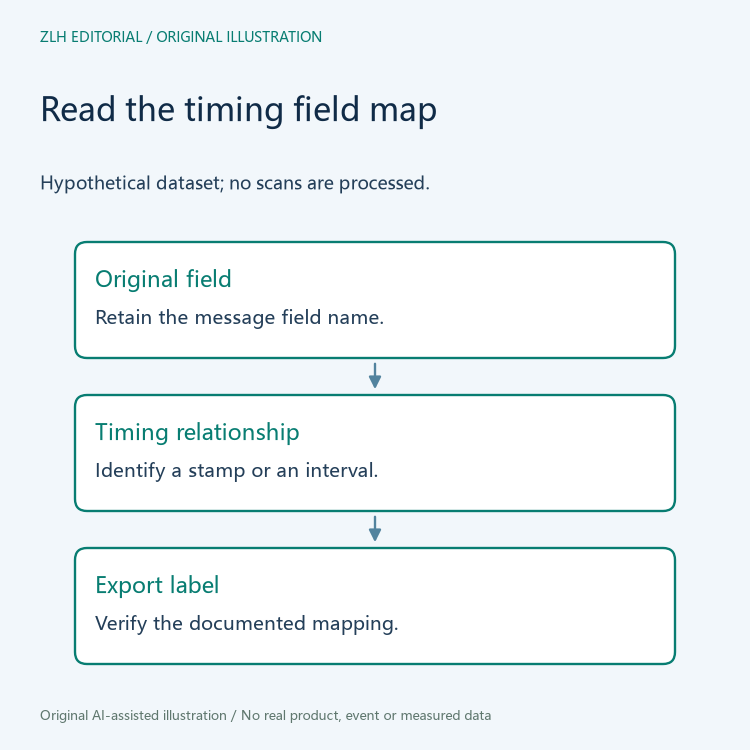
Can scan intervals be substituted for ray spacing?
A scan groups measurements, while the message gives the measurement interval its own field. If an export substitutes the interval between scans for the interval between measurements, it changes the documented meaning. This is a semantic problem even before any numerical calculation is attempted. A reviewer can identify it by inspecting the field mapping rather than by guessing the expected speed of the scanner.
Suppose a hypothetical supplier provides a dataset summary with one column labeled ray period and cites scan_time as its source. The reviewer can request a correction or an explanation of the transformation. The request does not establish that the original recording is unusable. It identifies a particular mismatch between the summary's label and the source field's documented role. Any revised export should retain its relationship to the earlier version.
The message comment also connects measurement timing to interpolation of point positions when a scanner is moving. Preserve that as the documented use context rather than treating it as a ready-made reconstruction procedure. This article supplies no interpolation formula, scanner trajectory or pose information. A message-field explanation cannot stand in for the additional evidence required to analyse actual moving-sensor observations.
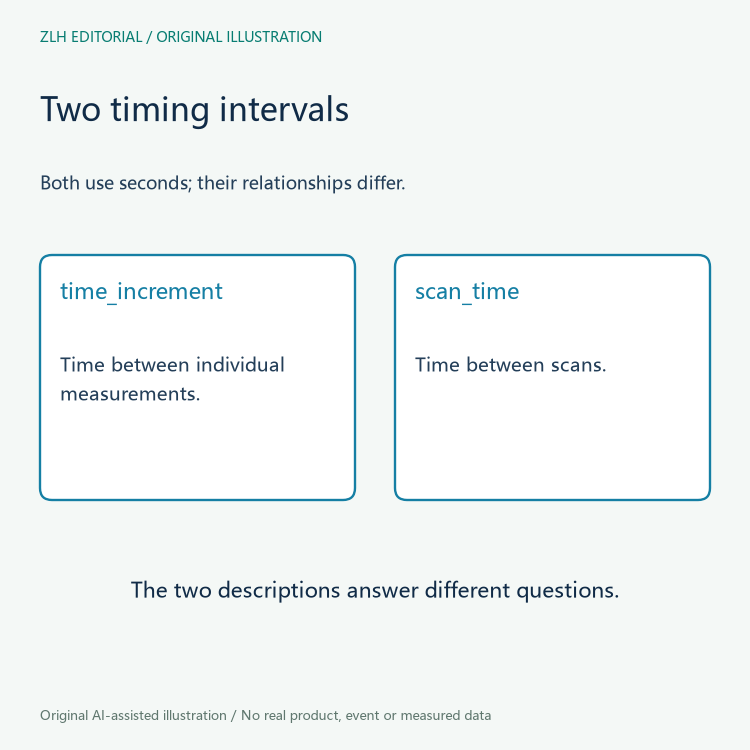
What should a timing dictionary preserve?
Preserve original field names, units, message type and the documented event or interval each field describes. If a downstream system uses shorter headings, provide an explicit mapping back to the source. The mapping should also identify copied values separately from derived values. This allows readers to ask a concrete question about a transformation instead of debating what an ambiguous heading might have meant.
Retain the dataset's stated ROS and message context. LaserScan is documented as a single scan from a planar laser range-finder, with a warning that applications make laser-specific assumptions. A different ranging device should not acquire those assumptions merely because its exported table has familiar column names. The actual contributor must explain what message type and collection method the dataset used.
If a field appears as zero or is missing from a table, this article does not infer the physical explanation. The contributor needs to identify whether the export omitted it, the source contained it or a transformation changed it. A missing field and a measured zero are different records. Neither should silently inherit an estimated value simply because another interval is available elsewhere in the message.
Both concept figures show documentation relationships rather than an observed scan or a timing benchmark. No sample values, measured rates or device-specific capabilities are asserted. More reading is available in the robot dataset category and related resource category. Keeping LaserScan timing attached to its first-ray stamp, measurement interval and scan interval gives database users a specific vocabulary for requesting an accurate data dictionary.


