

Camera Matrix Records: Raw Intrinsics and Rectified Projection
2026-11-05
Camera Matrix Records: Raw Intrinsics and Rectified Projection
Matrix records in a robot camera catalogue should distinguish the intrinsic parameters associated with raw images from the projection parameters associated with rectified images. A table that labels every matrix camera calibration may hide which image representation a field describes. This article reads ROS 2 Jazzy CameraInfo and image_pipeline documentation through a hypothetical catalogue appendix. It calibrates no camera, processes no image and projects no point.
Which representation does K describe?
The official Jazzy CameraInfo definition describes k as the intrinsic camera matrix for raw, distorted images. It separately gives distortion information and other calibration fields. Keeping k's representation context is necessary: a recognizable matrix shape or familiar focal-length symbol does not make every matrix in the message interchangeable.
For a hypothetical catalogue export, retain the original field identity rather than rename it simply intrinsic values. If the contributor has flattened a matrix into a list, ask which source field and ordering the list preserves. This is a request for a data dictionary, not a recommendation to reconstruct a calibration from an undocumented row of numbers. No such values have been supplied for analysis here.
Which representation does P describe?
The same definition describes p as a projection or camera matrix associated with the processed, rectified image. It explains that the left portion contains intrinsics for that representation and that these values may differ from those in k. A catalogue should retain that distinction even if a particular contributor's example happens to show matching values in some positions.
The official Jazzy image_pipeline Camera Info explanation discusses original-image projection and rectified output as separate stages. Its monocular and stereo discussion also preserves conditions under which input and output intrinsics may differ. These explanations locate the fields in a processing account; they do not establish what processing an unknown submitted dataset actually underwent.
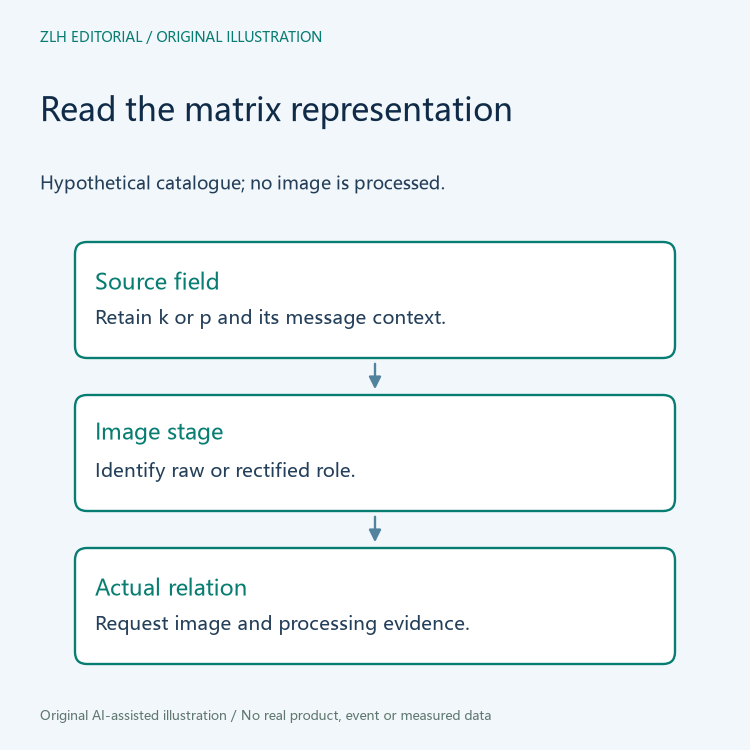
Does one matrix prove an image has been rectified?
A metadata field's presence is not an observation that a processing step was executed. The actual contributor needs to connect the camera-info record, relevant image and processing context. A catalogue can describe the declared matrix roles while leaving that connection unresolved. It should not silently label a supplied raw image rectified merely because a p field exists in the accompanying message type.
Suppose a hypothetical package includes an image and a metadata table with an unnamed matrix. The useful request identifies the image representation and the matrix's source field before any consistency claim is attempted. The reviewer should not pick whichever interpretation makes a preview look plausible. This article has not decoded a frame or compared image content with calibration parameters.
Equal-looking focal terms do not erase the two matrix roles either. The documentation describes conditions and representations, whereas the actual table needs its own applicable account. A copied example is not evidence that a real monocular or stereo setup meets those conditions. If the contributor claims equivalence for a specific record, retain the explanation and the exact records to which it applies.
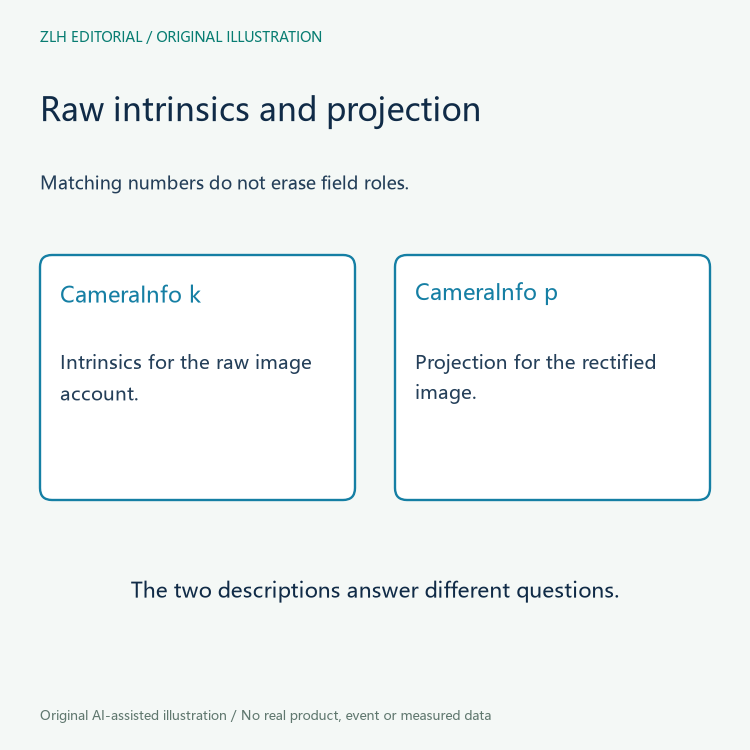
How can a catalogue preserve the relationship?
A useful entry distinguishes k and p by original field name, image representation and applicable documentation context. Other calibration information should remain available rather than disappear into the label matrix verified. If an export omits fields, list that omission. The absence of a field from a summary is different from a particular value present in the original message.
If a later correction changes a column heading from raw intrinsics to rectified projection, preserve why it changed and which source field supports the new heading. That correction does not itself mean the camera was recalibrated or a new image was acquired. If new evidence was supplied as well, identify that event separately so a reader can understand the revision.
The cited definitions are from Jazzy. Another interface or version needs its own applicable documentation. This article's matrix question is also distinct from catalogue dimensions or a region-of-interest description. Those fields can matter to a complete imaging account, but they do not replace the raw-versus-rectified role identified here. No compatibility, calibration accuracy or image-quality judgement follows from this reading.
Keep any actual processing report separate from the documentation explaining the field. A report should identify what ran and which records it concerned; a manual describes the interface without witnessing that event. The original diagrams contain no calibration values, scene points or measured errors. Their purpose is to make the representation question visible.
Related reading appears in the robot camera-data category and related resource category. Keeping matrix records attached to their raw-image and rectified-image roles helps catalogue users request the missing relationships without inventing an imaging result.


