

Robot Range Records: A Reading Does Not Select a Bearing
2026-11-05
Robot Range Records: A Reading Does Not Select a Bearing
Range Records do not always identify a unique direction to the object that caused a reading. The ROS Range definition says that the object may have been anywhere within the stated field of view at the measured range. A scalar distance should therefore not be silently turned into a point on the sensor's center axis. This article reads the Jazzy message definition and coordinate-convention context, without receiving sensor data or calculating an object position.
Confirm that the record uses this message type
The official Range definition describes a single reading from an active ranger and explicitly distinguishes it from the LaserScan message intended for laser scanners. A data note should retain the exact type before interpreting a display. A generic heading such as distance sensor does not establish which message semantics apply.
For this reading, the generated documentation identifies sensor_msgs Jazzy 5.3.8. It was read on November 5, 2026. An actual producer still needs its own interface context and applicable version. The definition does not prove that every unidentified sensor export follows the same representation or that a particular device has been examined.
Read field_of_view as the angular scope of the reading
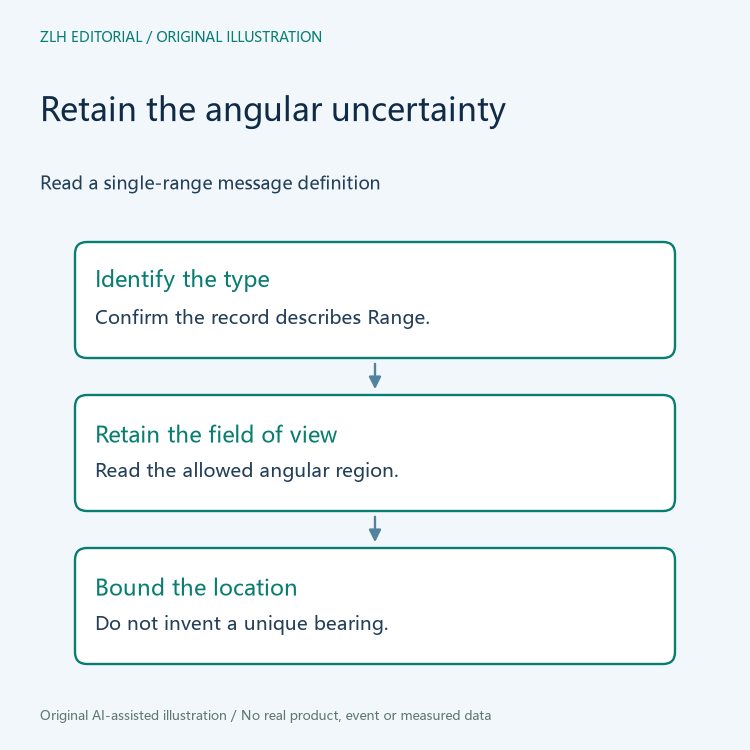
The message comments explain field_of_view as the size of the arc over which the reading is valid. They say that the object producing the reading may have been anywhere between minus half the field of view and plus half the field of view at the measured range. This leaves an angular region in the documented interpretation rather than selecting one observed bearing.
The scalar range and angular scope should remain associated in a data description. Removing the field-of-view explanation can make the distance look more spatially specific than the definition supports. This article uses the source's arc wording and does not infer a complete three-dimensional detection shape, a beam profile or a measured angular response from that comment.
Keep the center axis separate from an observed direction
The definition identifies zero angle with the sensor's x-axis. That gives an angular reference; it does not say that every object causing a reading lies on that axis. A center line drawn in a conceptual illustration should therefore remain a reference line. It should not become an invented measured direction for the object.
A data export that turns a reading into a single plotted point needs to explain the additional assumption or information used. The point's convenient placement in a drawing is not new sensor evidence. A receiving reviewer can ask for the representation rule without calculating coordinates or changing the producing system.
Preserve the sensor's coordinate context
The official REP103 coordinate-conventions document explains why units and frame conventions need consistent, documented interpretation, including justified exceptions. It provides context for keeping the sensor reference visible. A page-layout direction or a familiar robot-body label is not enough to establish the physical orientation of the particular sensor frame.
This article does not repeat a general axis glossary or compute a transformation. Its narrower point is that the angular reference belongs to the sensor context named by the message definition. A record needs the corresponding project explanation before that reference can be related to an actual installation or a displayed object location.
Review a fictional point-location caption
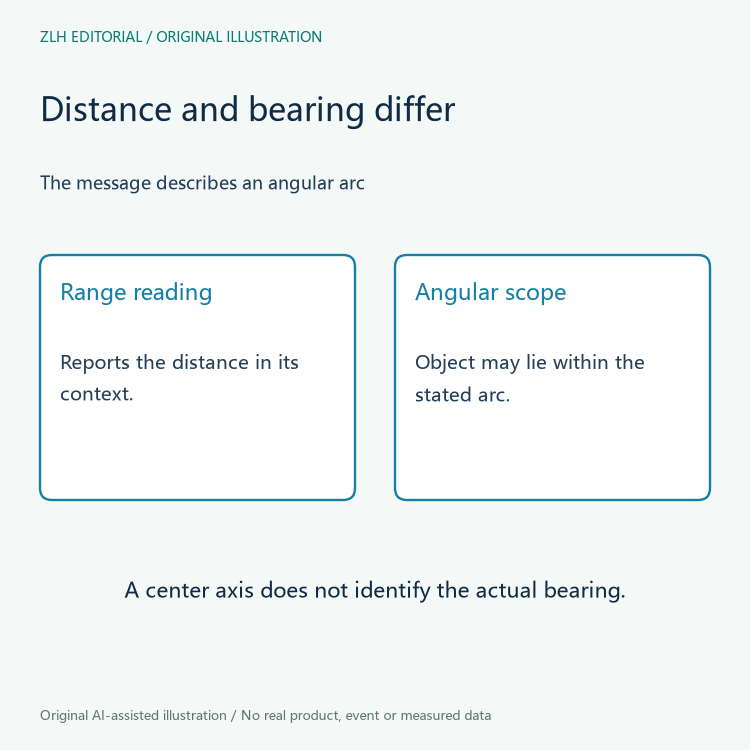
Imagine a fictional database illustration placing an object dot exactly on the sensor's center axis and calling it the measured location. Its only supporting material is a Range reading and a nonzero field of view. The reviewer should ask which evidence established the unique bearing. This invented example contains no distance value, real object or actual sensor return.
A corrected caption could describe the reading's angular scope and state that a unique bearing was not supplied. If a later source provides additional directional information, associate that information with the specific record rather than rewriting the earlier scalar reading as if it contained the bearing all along. This preserves the difference between source evidence and a later derived representation.
Leave spatial conclusions with appropriate evidence
The definition can explain the record's intended angular scope. It cannot establish the accuracy of a particular sensor, identify a physical obstacle or decide whether a robot may move. Those questions need actual equipment and suitable evidence. This review also does not reinterpret special floating-point states; its subject is the unresolved bearing associated with the stated angular region.
The original figures contain no fabricated object dot, measured arc or calculated coordinates. Related material is available in the robot sensor data collection and article directory. Keeping Range Records associated with their field of view prevents a database caption from inventing a unique spatial direction that the supplied reading did not establish.


